Sacred Economy x Global Economy
TL;DR
- The global economy is productive but extractive. A sacred economy is meaningful but vulnerable.
- The path between them: finance first shields a community while it weaves its own economy, then it meets the global economy on its own terms.
- The goal is for money to be transformed into a community’s values, not the other way round.
The tension
Section titled “The tension”The modern global economy is the system most of the world runs on: markets, capital, trade, growth, and money as the common measure of value. A sacred economy is one where the economy serves what people hold sacred: relationships, the living world, community, and the things that can’t be priced.
They look opposed. The global economy is powerful, productive and connected, but it tends to extract, flatten difference and turn everything into a commodity. A sacred economy is rooted, meaningful and regenerative, but on its own it can be small, under-resourced and vulnerable to being overrun.
This page looks at the tension between them, then at a picture of the journey from one to the other. (For the general method, see Beyond Dualism.)
The dialectic
Section titled “The dialectic”- Thesis: the global economy. It feeds billions, spreads tools and knowledge, and lets strangers cooperate at planetary scale. Pretending we can simply leave it is a fantasy.
- Antithesis: the sacred economy. Some things are worth more than any price: land, kin, culture, the living world. An economy that can’t see them will consume them.
- Synthesis: sacred economy, interfacing on its own terms. Communities weave their own economy first, shielded from extraction. When they’re ready, they meet the global economy deliberately, so that money is transformed into their values instead of their values being transformed by money.
Towards a more sacred economy
Section titled “Towards a more sacred economy”We want to bring people from the modern global economy into a sacred economy.
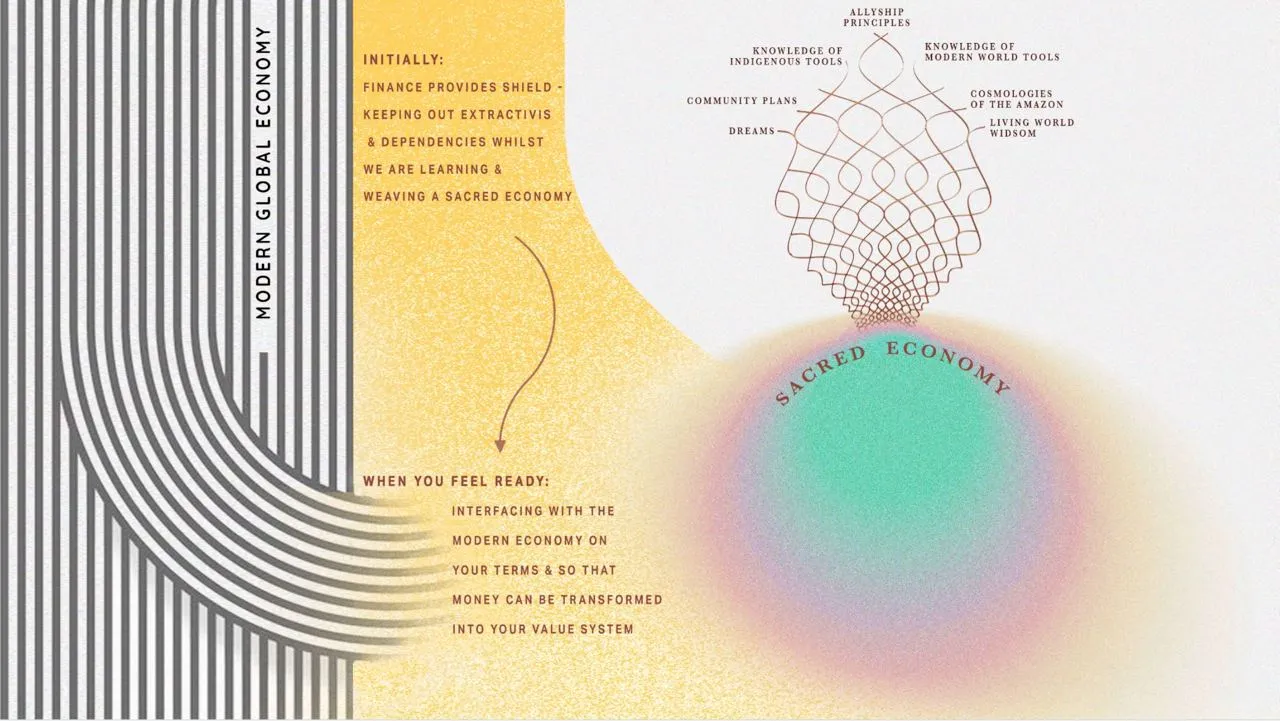
Image by @lai.
What the picture shows
Section titled “What the picture shows”The image reads left to right as a journey in three parts: where people start, a protected middle, and where they’re headed.
From: the modern global economy
Section titled “From: the modern global economy”On the left are rigid, parallel grey lines. That’s the modern global economy: uniform, mechanical, and built to pull everything into the same channels.
Those lines bend toward the right and start to fray. The old system doesn’t vanish; it reaches into the space beside it.
The middle: finance as a shield
Section titled “The middle: finance as a shield”The yellow band in the middle is a protected space, and it has two stages.
Initially, finance provides a shield. Money keeps out extraction and dependency while a community is learning and weaving a sacred economy. In this stage, funding isn’t there to plug people into the global economy. It buys them time and room to build something of their own.
When you feel ready, you interface with the modern economy on your own terms. The community chooses when to engage, and the goal of engaging is specific: so that money can be transformed into your value system, instead of your values being transformed by money.
The order matters. Shield first, then interface. Connect too early and the bigger system sets the terms.
To: a sacred economy
Section titled “To: a sacred economy”On the right is the sacred economy: a soft, glowing field of color rather than a set of lines. Above it is a woven net, and each thread is one of the things it’s made from:
- Dreams
- Community plans
- Knowledge of indigenous tools
- Allyship principles
- Knowledge of modern world tools
- Cosmologies of the Amazon
- Living world wisdom
Two details stand out. First, it’s woven: these threads only become an economy when they’re braided together. Second, modern world tools are one of the threads. A sacred economy doesn’t reject the modern world; it takes what’s useful and weaves it in alongside older knowledge.
What it means for love.fund
Section titled “What it means for love.fund”This is a picture of what Love x Fund is reaching for: money that serves what people love, rather than people serving money. It suggests a few things about how we fund:
- Funding can be protective. Sometimes the most useful thing money can do is give a community room to learn without having to sell out to survive.
- Let communities set the pace. “When you feel ready” is their call, not the funder’s.
- Translate money into values, not the other way round. The point of engaging with the wider economy is to bring money into a community’s value system.
- Weave, don’t replace. Dreams, community plans, indigenous knowledge and modern tools all belong in the net.
What each side protects
Section titled “What each side protects”| Pole | What it protects | What it becomes alone |
|---|---|---|
| Global economy | Productivity, connection, access to tools and capital | Extraction and commodification |
| Sacred economy | Meaning, relationship, the living world | Isolation and vulnerability |
A good synthesis keeps the left column of both rows and avoids the right column of both.
The assumption to question
Section titled “The assumption to question”The two look incompatible because we assume contact always flows one way: the bigger system absorbs the smaller, and money always reshapes values in its own image.
But the direction depends on the terms. When a community engages from a position of strength, with its own economy woven and its own values clear, it can take what’s useful from the global economy and bring it inside. In the picture above, modern world tools are one thread of the sacred economy’s net, woven in alongside dreams, community plans, indigenous knowledge and living world wisdom.
When to hold them apart
Section titled “When to hold them apart”Not every case wants a synthesis. Some things should stay outside the market entirely: sacred sites, ceremonies, knowledge that isn’t meant to be sold. And sometimes a community needs to refuse a deal outright, because the terms would capture it.
The point is that the boundary is the community’s to draw.
The upward spiral
Section titled “The upward spiral”The global economy without the sacred becomes extraction. The sacred without any interface to the wider world becomes fragile.
Done well, each one feeds the other. A sacred economy gives money a compass, and the global economy gives the sacred the tools and reach to grow. This is what Love x Fund is reaching for: money that serves what people love, rather than people serving money.
Disclaimer: This resource is for informative purposes only and is not financial advice. This resource reflects the personal views of members of the Gitcoin community, not a decision or commitment by Gitcoin governance. Forward-looking items in it are targets, not commitments. The information in this resource is subject to change as we continue learning. This resource may contain estimates, may contain errors, and is provided on a best-effort basis. Double-check any information that isn't onchain, and don't make financial decisions based on this resource. Nothing here is an offer to sell, or a solicitation to buy, any security, token or investment. GTC is a governance token and gives holders no right to the revenue, profits or assets of Gitcoin or love.fund. Mentions of other organizations don't imply a partnership or endorsement unless stated. Content is licensed CC BY-SA 4.0.