love.fund is being designed in the open.These are our working docs and things are changing fast. Expect a firmer path forward by Q1 2027.Get involved →
An ecosystem of funding apps, incubated at Gitcoin: pilots and campaigns that route money to the people and places doing the work.
TL;DR
love.fund is an everything app for funding what matters: pilots and campaigns that route money to the people and places we love.
Its applets share distribution and go-to-market, so each one builds momentum for the rest.
This site lays out love.fund’s ontology, context and plan, for Gitcoin fans and for the AI agents helping steward it.
love.fund is an everything app that fund what matters.
We facilitate pilots and campaigns that route money to the people and places we love. We give applets shared distribution and a shared go-to-market presence. Each app solves a piece of the puzzle in its own way, builds network effects, and together the ecosystem is stronger for it - the app builds momentum for the entire ecosystem of applets.
We are exploring the following:
Is there an opportunity to build a kickstarter for the AI era?
How might we reimagine collective action and fundraising for the AI/crypto era?
How might we disrupt the non-profit industrial complex?
How can we take what worked about Gitcoin into the 2030s?
How might network effects be leveraged? How might we build/share network effects together? How might we build shared distribution?
What are the commanding heights in the new economy? How can they be owned by the people whose resources they direct?
This site is an exhaustive definition of the ontology, context, & plan for love.fund
This site is made for Gitcoin fans - especially those who want to follow Gitcoin’s path forward.
This site is made for AI Agents - especially those who are actively stewarding love.fund.
We may create a more human-readable tldr at some point when things settle.. But for now, if youre looking for something less verbose, throw this docs site at your AI chatbot and ask it questions.
Evolve software in conversation with the community. This is the main lesson. The best product decisions came from shipping, listening and adjusting with the people using it, not from planning in isolation.
Go broad, then go deep. We built a handful of products, like bounties, hackathons, Kudos and quests, before we landed on Gitcoin Grants. A breadth-first search found what worked; a depth-first search turned it into something people relied on.
The first version is never the one that works. Even after we found Gitcoin Grants, we had to iterate on it, round after round, to make it useful.
When launching a funding campaign, set an $$$ anchor first. Matching pools are the anchor point of a crowdfunding campaign. They are what make quadratic funding work. A round without a funder behind it is just a promise, which is why the first question for any pilot is where the money comes from.
Campaigns have to pay their way. For years Gitcoin funded public goods out of its own treasury. In 2025 it had to cut spending and shed organizational debt to get back to a stable footing. That’s why love.fund campaigns share revenue back.
Curate and fund, and let operators operate. Gitcoin started to see much more innovation when partners ran their own rounds on its rails, and its 2027 strategy leans on that network: operators run rounds, curators surface signal, capital partners fund. love.fund screens and backs sub-allocators;
Anything that counts people will get gamed. Quadratic funding rewards how many people give, so it attracts fake accounts. Gitcoin built Passport (now Human Passport) to fight that. Any love.fund mechanism that pays out per person needs a sybil plan from day one.
Trust is the product. Donors come back when payouts land on time and the reporting is clean. Software and operations decide whether a second round happens.
Quadratic funding is a growth machine, not just a fundraising machine. Because QF rewards how many people give, every project has a reason to rally its community, and every donor discovers other projects along the way. Lots of people found each other through Gitcoin: builders found funders, collaborators and co-founders. The network it grew was worth as much as the money it moved.
Pair big brains with builders. Working with thinkers like Vitalik Buterin and Glen Weyl was a gift. They reasoned a priori, from first principles; we were empirical, learning from what actually happened in each round. The mechanism got better because both sides kept talking: theory told us what to try, and the rounds told us what held up.
Lessons from the GTC retrospective, which looks back on the five years since GTC launched in 2021:
Walking out of a corporate parent can work. Most projects born inside a corporate parent die inside it. Gitcoin spun out of Consensys, launched GTC three months later and handed the project to its community.
Keep the promises you make. The 2021 launch video promised that GTC holders would govern the treasury, settle disputes, create policy, ratify grants rounds, fund community collections and fight sybils. All of those happened, even where some mechanisms didn’t scale.
The category can outgrow its creator. Quadratic funding spread to Octant, Giveth, Artizen and others. Ideas spread even where the product didn’t win.
Building a DAO that works is hard. We had a lot to learn. 2021–2025 brought hard debates over budgets and direction, reorgs and layoffs, and relationships that still need repair.
Ship, or lose the lead. The hardest regret: we lost the lead in a market we created, and we didn’t ship the software we wanted to ship.
Archive what you can’t afford to lose. When the Gitcoin Media YouTube channel went away, years of talks and educational content went with it.
Markets move under you. Public goods funding tools declined as ETH stagnated and risk capital moved to AI. A funding model has to survive the cycle it was born in.
Be clear about what a token is. GTC launched as a governance token with no promised economic value, and that hasn’t changed. It’s for governance, not a share of anything Gitcoin or love.fund earns.
Name the hurt, then release it. Repair means naming harms specifically and separating people from circumstances. Forgiveness doesn’t mean the decisions were right.
Gitcoin 2.0 bet on software. The whitepaper laid out the plan: Grants Stack, a no-code, “enterprise-grade” app for running grants programs, built on Allo Protocol, sold to the “hundreds of DAOs with millions of capital to distribute.” It expected that market, then “limited to organizations with token treasuries,” to grow “by many orders of magnitude” as more assets moved onchain, and set a north star of funding $1B in grants.
The tools worked, and partners ran real rounds on them. The business didn’t:
Size the team to the market you have, not the one you expect. Web3 grants programs weren’t a big enough market to carry a large team. Even a good product in a small market can’t pay for a big org.
Don’t build on a single customer base that can dry up. The customers were DAOs funding their ecosystems from token treasuries. When token prices fell and risk capital moved to AI, DAO grant budgets dried up, and so did demand for the tools to run them.
“Orders of magnitude” is a bet, not a plan. The growth case depended on tokenization reaching far beyond crypto. That may still happen, but it didn’t happen on a timeline we could wait for.
Treasury-funded customers are cyclical. When the people paying for grants are spending a treasury rather than earning revenue, the grants market rises and falls with token prices.
In August 2024 Kevin laid out a 10-year goal: “What Stripe did for accepting credit cards, Allo could do for capital allocation.” Horizon 1 was to win the grants market and break even by the end of 2025. Horizon 2 was to make Allo the capital allocation layer of a tokenized internet, a market he framed in the trillions. In January 2025 Allo Protocol spun out of Gitcoin as Allo Capital, a standalone company backed by Gitcoin and Protocol Labs. It shipped AlloKit, Allo Protocol, Deep Funding, Cookie Jar, InfiniteRegen.AI, and a few other experiments. In May 2026 it wound down.
Cheap experiments on shared rails can beat expensive builds. The 2024 build table told the story: Gitcoin’s own QF stack cost millions and moved about $0.92 of funding per dollar spent. EasyRetroPGF cost $200k and moved about $25 per dollar. Partners built several strategies on Allo at no cost to Gitcoin.
Shipping isn’t product-market fit. Allo Capital shipped four interesting products. None of them reached product-market fit or scalable revenue.
Developer tools are only as good as the developers who want them. The bet was a protocol plus AlloKit, a toolkit for developers building funding apps onchain. Then the world moved to AI. The builders and the capital went with it, and an onchain toolkit for funding apps stopped being relevant to what most developers were building.
A spinout needs a founder with free attention. A separate company was meant to buy focus, but Kevin’s attention went back to Gitcoin, and the venture suffered for it.
An ontology is a picture of what exists and how it relates. It’s the set of basic categories you use to make sense of the world: what’s real, what matters, what counts as value, and how things connect to each other.
Everyone has one, whether they’ve written it down or not. Most of the time it’s invisible, because it’s the lens you look through rather than something you look at.
An ontology informs everything downstream of it. What you believe exists shapes what you notice. What you notice shapes what you measure. What you measure shapes what you fund. And what you fund shapes the world.
You can see this in economics. If your ontology says that value is whatever has a price, you build markets that are blind to relationships, the living world and everything else that can’t be priced, and then you’re surprised when those things get used up. If your ontology says that people are isolated individuals maximizing their own gain, you design institutions that make that true.
Change the ontology, and different things become visible, different mechanisms make sense, and a different economy becomes possible.
Thousands of mimetic tribes, talking past each other
There are thousands of mimetic tribes out there: groups held together by a shared story about what’s real, what’s good and who the enemy is. Each one has its own ontology, its own vocabulary, and its own sense of what’s obvious.
What you see on social media these days is mostly these tribes talking past each other. The same word means different things to different groups. An argument that’s airtight inside one ontology sounds absurd, or even dangerous, inside another. People aren’t only disagreeing about answers. They’re working from different pictures of what exists, so they can’t agree on what the question is.
That raises a hard question: how can we understand the points other people are making when we don’t have an ontological transmission protocol, and most of us can’t think from inside another ontology?
Our ontology informs everything we do: the mission, the roadmap, the mechanisms we experiment with, the record types our apps read and write, and how we decide what counts as success. If we skip this step, we inherit the ontology of the economy we’re trying to move beyond, and we end up rebuilding it with better tools.
So we try to make ours explicit. The pages in this section lay it out:
Today, the things that matter most are often funded last. Care work, local places, open source, public goods, ecosystems and the people holding communities together run on leftover money, volunteer hours and grant cycles that end before the work does.
A world where what matters is funded well would look different:
Funding is steady, not heroic. People doing essential work don’t spend half their time asking for money. Support arrives on a rhythm they can plan around, for years, not one grant at a time.
Money follows what people actually value. Anyone can point their money at the people and places they love, and many small gifts can count for more than one large check.
Decisions sit close to the work. The people who know a place or a problem help decide where the money goes, and anyone can see where it went and what it did.
What can’t be priced still gets paid for. A forest, a tradition, a neighbor who checks on the elderly: the work markets miss has a reliable way to get funded anyway.
Funding builds relationships. Giving leaves people more connected to each other and to where they live, not just settled up.
None of this needs new values. Most people already know what matters to them. What’s missing is the rails: ways to pool money, decide together, trust each other at scale and see results, that are as easy to use as the rails built for extraction. Our beliefs explain why we think those rails are possible now.
A network business beats every other kind of company. A normal company’s value grows with its number of customers; a network’s grows with the connections between its users, and it takes a slice of every one. Inside a category, the biggest network ends up larger than everyone else combined, so investors learned to fund only network plays with a credible path to number one.
Money moved to the virtual, and the physical got debased
Once bits and money moved at the speed of light, returns in the virtual economy beat returns in the physical one, and capital followed. Everything that stayed physical got debased: the local shop, the road, the town. The gains went to a few, the costs were spread wide, and all of that market cap came out of real places.
Network companies were built on things taxpayers paid for, like roads, telecom and public research, and then grew past the borders of any one country. With tax threats, lobbying, litigation, media and revolving doors, they became more influential over the state than the state is over them.
Government’s job shrank to maintenance: fill the potholes, keep the lights on, collect the taxes and enforce the rules of a system most people have no say in. The people who funded the network era called this inevitable, and good news for anyone who got in early. We don’t think it was either.
What we want instead: the virtual feeds the physical, so the screen’s job is to get you off it and into a place with people. Power is distributed, with every town running its own economy and having its own say, networked to every other town. And the synergistic satisfiers come back: places, like a good bookshop or a town square, that meet several human needs at once.
AI is reshaping work faster than people can retrain for it. Big Tech is spending hundreds of billions of dollars a year on compute, while tech companies cut jobs by the thousands.
Crypto spent the last decade building rails that move value across the internet with no bank in the middle. Open source software, cheap hardware and AI tools keep lowering the cost for strangers to build something together.
Trade routes, alliances and supply chains that looked settled ten years ago are being renegotiated in real time. That leaves a lot of people asking which institutions they can still count on, and where they’d go for help if the answer is fewer than they thought.
For most of modern history, funding anything meant going through an institution built for the industrial era: a bank, a government program, a foundation with a board and an annual grant cycle, a corporate budget. Those institutions make a small number of large decisions slowly, and they ask everyone else to trust the few people inside.
For the first time in history, we can fund things with networks instead. A group of people who may never meet can pool money and decide together where it goes, in public, at internet speed and at any size. Gitcoin has done this for 8 years and moved more than $60M through 230+ rounds that way (see the track record).
Money used to move only as fast as banks and paperwork allowed. Now it can carry rules: match this donation, stream this grant, release this payment when the work is done, send a share upstream. Funding mechanisms that used to need an institution can now be written as software.
Judgment, analysis and allocation used to be scarce and expensive, so only big funders could afford to do them well. AI makes that intelligence cheap and abundant. An everyday donor can now have the kind of research and allocation help that once took a foundation staff.
atproto lets communities build network effects together
On the old internet, network effects belonged to whichever platform held the data, so every community built someone else’s moat. On atproto, people own their identity and their data, and apps share open record types. Every app that adds a vouch, a donation or a relationship makes every other app more useful, and a community can leave without losing its graph. Network effects stop being something a platform captures and become something communities build together and keep. See Architecture.
Where we are isn’t inevitable. It’s the product of incentives to extract as much as possible, push the costs onto someone else and concentrate the power that results. The technology doesn’t require those incentives. A different everything app uses the same network math and the same technology, but measures success by needs met instead of time on screen, and pushes wealth and power out to towns and bioregions instead of up to a few owners. That’s what love.fund is building.
The nonprofit industrial complex is ripe for disruption
Much of philanthropy runs through layers of intermediaries, grant cycles and reporting that cost a lot and keep money far from the people doing the work. Programmable money, networks, cheap intelligence and public, transparent funding flows make a more direct path possible.
The social safety net is being renegotiated right now
The safety nets of the industrial era were built for a world of stable jobs, and that world is going away. Whatever replaces them is being decided now, in policy, in markets and in communities. We want communities to have a real hand in it.
An app is the small thing you see, and the interface to a very large thing you don’t: warehouses, data centers, satellites and the local businesses they replaced. An everything app routes every need, purchase, relationship and vote through one front door. The question is who owns that door.
On the old internet, every app fought alone for attention, and distribution went to whoever owned the front door. When apps share identity, data and record types, an everything app doesn’t have to be one company’s product. It can be many apps behind one front door, where a person who arrives for local events can find a gift circle, a funding round or a neighbor’s project without starting over. Each app brings people in, and every other app gets to meet them. Distribution becomes something apps build together and share, not something one owner rents out.
The commanding heights are the chokepoints that control an economy, and the flows that run through them. Whoever controls how AI’s economic value flows, not just who builds the intelligence, shapes the next era.
Build the commanding heights of the traditional economy.
Technology came from people, from people coordinating in person, and from a living biosphere, so it has to leave all three stronger: healthier people, better in-person coordination and a better biosphere. Anything that grows by debasing what it came from is a cancer. Every feature gets the same test: is the thing it emerged from stronger afterward?
In the fullness of time, jobs are a pier, not a bridge
We’ve been told jobs are a bridge: work hard, and they carry you safely to a life of abundance. After AI - and the changes to the social contract in the last 20 years, they look more like a pier: they go out a ways and then they end. As AI automates more work, people need other ways to be held, by each other, by their communities and by funding that follows what they love.
When value circulates close to home, it builds relationships and resilience instead of leaking away. Local and bioregional economies, mutual aid and community-owned commons are part of how people get through what’s coming. See Local x Global.
Regeneration, not extraction, is the long-term meta
Extraction wins in the short run, and then it runs out of things to extract. Over the long run, the strategies that last are the ones that leave people, places and the living world better off than they found them. See The Upward Spiral.
Gift circles, mutual aid, commons and rotating savings kept people fed and held for thousands of years, long before banks, insurers or welfare states. The way forward isn’t a return to the past, and it isn’t a clean break from it. It’s a chance to re-indigenize and re-relationalize ourselves: to remember that an economy is made of relationships, with each other and with the living world, and to rebuild it that way with the tools of this era. And the timing matters: this is happening just as the institutions of the industrial era (stable jobs, pensions, safety nets, trust in big institutions) are decaying. As they fray, the oldest ways of holding each other are what’s left, and they’re coming back exactly when they’re needed. The phrase is Helena Norberg-Hodge’s. See Ancient futures.
Many of our deepest tensions come as pairs of forces that look opposed: love and money, sovereignty and interdependence, individualism and collectivism.
We tend to treat these as binary choices - and much of contemporary discourse on social media is people talking past each other. But the tension between two opposites can be generative, something to work with rather than something to get rid of.
The goal isn’t always to choose a side. It’s to find out what becomes possible when both sides interact.
Most political economy commentary is stuck in capture, dogmatism, and dualisms. By moving beyond dualisms of the past, we have an opportunity to create something better.
The fruits of this exploration are:
Innovation. Apparent contradictions can point to design spaces nobody has explored.
Coordination. Opposing interests can become complementary incentives.
Wisdom. Holding competing truths keeps you from ideological rigidity.
Systems design. A good synthesis can turn a zero-sum tradeoff into a positive-sum feedback loop.
There are a few skillful moves you can make with a pair of opposites, and it helps to be able to toggle between them.
Pull them together into a new frame. Find a synthesis that keeps what each side does well and makes something neither could on its own.
Hold them in conversation. Keep both sides distinct and let them check each other, so you don’t force a merger that flattens them.
Which one fits depends on context and on what you value.
Take love and money. Love runs on generosity. Money runs on exchange. A synthesis might look like regenerative economics: an economy that values care and lets capital flow toward it. But you might also want to hold them apart, so that generosity doesn’t end up priced like a market good. Both moves are legitimate. The skill is knowing which one a situation calls for.
Three formal ways to work with opposites:
Approach
Core question
Outcome
Dialectics (Hegel)
What new idea emerges from the tension?
Synthesis
Polarity management
How can both sides stay healthy?
Dynamic balance
Nondualism (Eastern philosophy)
Are these opposites fundamentally separate?
Transcending the binary
These complement each other. They aren’t interchangeable. Dialectics looks for a third thing. Polarity management keeps two things in a healthy rhythm. Nondualism questions whether there were ever two things to begin with.
A good synthesis keeps the strengths of both poles and opens up a new possibility. The process looks like this:
Identify the opposing forces and what each one protects.
Interrogate the assumptions that make them look incompatible.
Synthesize a new system that keeps the strengths of both.
Balance the poles when synthesis isn’t possible or isn’t wanted.
Iterate, because every synthesis produces new tensions of its own.
Not every contradiction deserves a synthesis. Some differences can’t be reconciled, and some values need hard boundaries. Sometimes a proposed synthesis is just a tradeoff in disguise.
There is danger in assuming every conflict has a beautiful middle ground. A real synthesis produces something better than either side. A compromise between two imperfect options doesn’t.
Progress may come less from eliminating tension than from making it productive.
Love without economic infrastructure struggles to scale.
Money without love loses its compass.
Sovereignty without interdependence becomes isolation.
Interdependence without sovereignty becomes dependency.
The next generation of institutions might be built by designing systems where each force makes the other stronger, rather than by choosing between them.
The goal isn’t to erase opposites. It’s to turn their tension into an upward spiral.
The dialectics that follow this page in the sidebar each take one pair and work through it: what each side protects, the assumption that makes them look incompatible, what a synthesis looks like in practice, and when to hold them apart instead. love.fund itself starts from the first one, love and money.
A lot of the tensions we live with come as pairs that look opposed: love and money, sovereignty and interdependence, the individual and the collective. We usually treat them as a choice and pick a side.
A dialectic does something else with them. It takes the tension as material to work with. You ask what each side protects, question the assumption that makes them look incompatible, and look for something new that keeps the strengths of both. The answer often turns out to be a design space nobody had explored yet, or a way to turn a zero-sum tradeoff into a loop where each side makes the other stronger.
It has limits. Some differences can’t be reconciled, and some values need hard boundaries. A proposed synthesis can also be a tradeoff in disguise. A real one leaves you with something better than either side, which a compromise between two imperfect options doesn’t.
Love and money is a good pair to try it on. Love without economic infrastructure struggles to scale. Money without love loses its compass. The aim is to make the tension between them productive rather than pick one.
For more on working with opposites, including when to merge them and when to hold them apart, see Beyond Dualism.
love.fund starts from a question: what if we could fund what we love, and love what we fund? It works as a dialectic.
Thesis: fund what we love. Let money follow what people actually care about, as they name it themselves.
Antithesis: love what we fund. Funding creates attachment. Sometimes that’s good, because attention turns into stewardship. Sometimes it’s bad, because we talk ourselves into loving whatever our money is already in.
Synthesis: money that flows like metta. Metta is lovingkindness, and money could move with its properties: unconditional, widening, growing when it’s given, practiced instead of transacted.
Point your time, attention and money at what you actually love, rather than at surface wants, because that alignment is what changes a person, and enough changed people change a society.
Start by getting clear on your deepest commitments. Preferences are things you happen to like, and addictions are things that pull at you whether you like them or not. Either one can pass for a value if you don’t look closely.
Then check whether your actions match. One test: imagine looking back on your life at its end. Which of this week’s choices would you be glad you made?
Loving an abstract idea like localism is different from loving specific people, specific places or the natural world.
Stay devoted to the core values and let the tactics move. A strategy is a guess about how to serve what you love, and guesses should change when you learn something.
Money is one resource among several. The economy has six, and all of them should follow your values:
Resource
What it is
Atoms
Physical stuff: food, materials, goods
Energy
Power, fuel, heat
Bits
Information and data
Currency
Dollars and other money
Attention
Your seconds, where your focus actually goes
Creativity
What you make, imagine and build
Each one can flow toward what you love or away from it. Money gets most of the scrutiny, but an hour of attention or a weekend of creative work says something about what you care about too.
The scorecard is a self-assessment: how well do your values match where your time, money and creative effort actually go?
Most of the evidence already exists. Your calendar shows where the hours went and your bank statement shows where the money went; set them next to the list of things you say you love and see how far apart they are.
Dharma is an old Sanskrit word for the thing you’re here to do: your purpose, your calling.
Purpose stays abstract until it shows up in where your time, attention and money actually go. Point those at what you truly love, and your dharma stops being an idea and becomes the life you’re living.
Sovereignty is the ability to decide for yourself: your own values, your own resources, your own path. Interdependence is the fact that none of us make it alone. We rely on other people, on communities and on the living world for almost everything.
They look opposed. More of one seems to mean less of the other. Lean too far toward sovereignty and you end up isolated. Lean too far toward interdependence and you end up dependent.
The question is whether you can design for both at once. (For the general method, see Beyond Dualism.)
Thesis: sovereignty. People and communities should be able to set their own course, hold their own resources and say no. Without that, cooperation is just control under a nicer name.
Antithesis: interdependence. Everything we care about is held in common: ecosystems, knowledge, culture, care. A self that refuses to depend on anyone can’t do much and can’t be cared for.
Synthesis: networked sovereignty. Autonomy that gets stronger through voluntary cooperation. You join because it serves what you love, you can leave if it stops, and the network is better because its members are free.
The two look incompatible because we assume that relationship costs autonomy, that every tie is a constraint.
That’s true of ties you can’t leave. It’s much less true of ties you chose and can exit. Consent and exit are what turn dependency into interdependence. When joining is voluntary and leaving is possible, connection can make you more capable instead of less free.
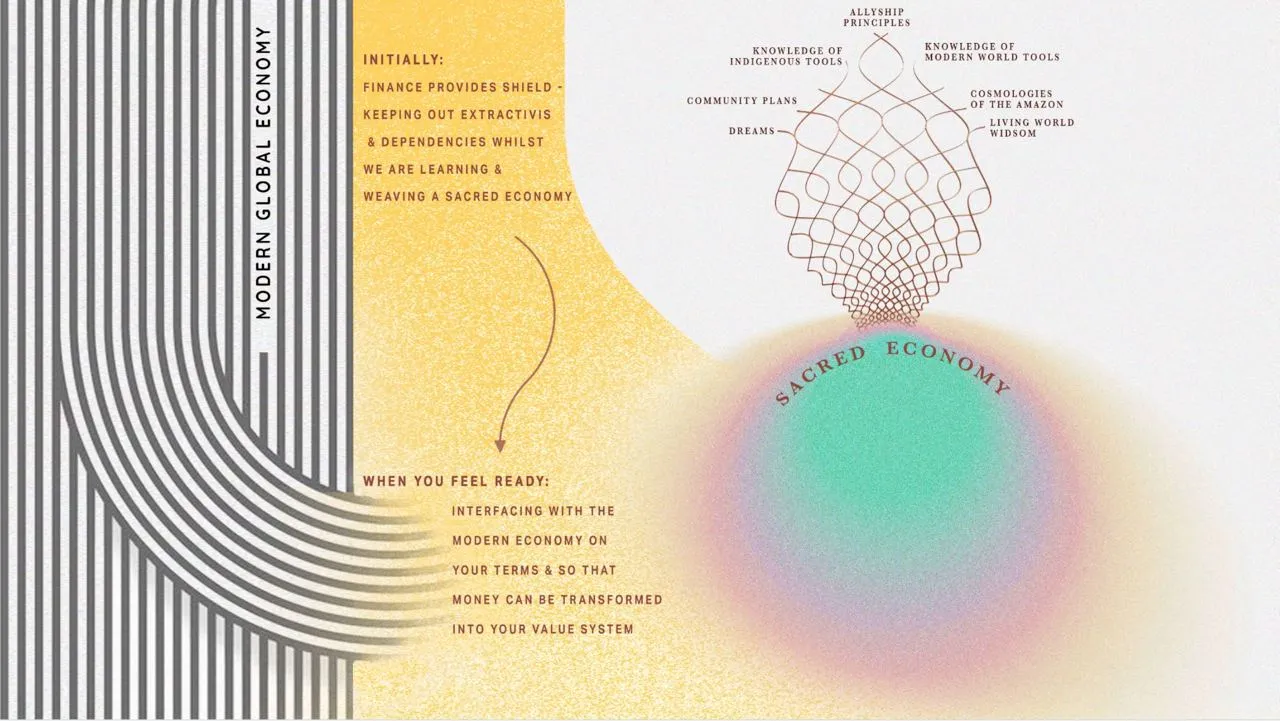
Communities that can say no. In the Towards a More Sacred Economy picture, finance first shields a community from extraction while it builds its own economy, then lets it meet the wider economy on its own terms. That’s sovereignty first, then interdependence by choice.
Funding without capture. Money can connect a project to a wider network without handing over control of what the project is for.
Federation over centralization. Many small, self-governing groups that coordinate where it helps, rather than one big group that decides for everyone.
Mutual aid. People keep their independence and still show up for each other, because the relationship is reciprocal and freely chosen.
The same tension at scale: individualism and collectivism
Zoom out from a person or a community to a whole culture and the same pair shows up as individualism and collectivism. Individualism puts the person first: their rights, their choices, their story. Collectivism puts the group first: its needs, its harmony, its continuity.
Pole
What it protects
What it becomes alone
Individualism
Freedom, creativity, personal responsibility
Atomization, loneliness
Collectivism
Solidarity, shared purpose, care
Conformity, groupthink
The synthesis is pluralism: collective intelligence that amplifies individual agency. Many different people and groups keep their own views, and the system is built to combine them instead of averaging them away. Quadratic funding and plural voting work like this, giving weight to how many distinct people care about something rather than to how much any one of them holds.
It’s networked sovereignty one level up. Free individuals make a smarter collective, and a good collective gives individuals more room to be themselves.
Not every case wants a synthesis. Sometimes sovereignty needs a hard boundary: a community protecting its land, a person protecting their body, a group refusing a deal that would capture it. And sometimes interdependence has to come first, as in a crisis where people need care before they can talk about autonomy.
The point is to keep both values in view, and to notice when a “partnership” is really dependency or when “independence” is really isolation.
Profit is what keeps an enterprise alive: revenue above costs, enough to pay people, reinvest and keep going. Purpose is why the enterprise exists at all: the people, places or problems it’s there to serve.
They look opposed. Chase profit and purpose gets trimmed whenever it’s expensive. Chase purpose and the money runs out. Most organizations end up picking one and apologizing for the other.
The question is whether an enterprise can make money because it does good, rather than in spite of it. (For the general method, see Beyond Dualism.)
Thesis: profit. An enterprise has to sustain itself. Without a surplus there’s no resilience, no growth and no independence from donors or patrons.
Antithesis: purpose. An enterprise should serve something beyond itself. Without that, profit becomes the goal and the work becomes whatever pays.
Synthesis: regenerative enterprise. Creating economic value by creating social and ecological value. The more good it does, the more it earns, and the more it earns, the more good it can do.
The two look incompatible because we assume value is captured at someone else’s expense. If every dollar of profit comes from cutting a corner, underpaying someone or pushing a cost onto the commons, then profit and purpose really are at war.
But value can also be created. When an enterprise earns its revenue by making people healthier, places more alive or communities more capable, the money and the mission come from the same act. The trick is to line up what gets paid for with what actually matters.
Revenue tied to outcomes. Get paid for the result you care about, such as restored land or people actually helped, not just for the activity.
Owners who share the purpose. Stewards, cooperatives and community owners are less likely to sell the mission for a quarter’s numbers.
Surplus that flows back. Profit gets reinvested in the people and places that produced it, not only extracted to distant shareholders.
Funding what you love. On love.fund, capital follows what people care about. When the funders are the people who love the work, profit and purpose stop pulling in different directions.
Not every case wants a synthesis. Some work matters and will never pay for itself: care for the dying, art nobody will buy, protecting a place from development. Forcing that work to turn a profit can distort it or kill it. It deserves gifts, grants and public support, not a business model.
And sometimes “purpose-driven” is just marketing. A real synthesis shows up in where the money goes and who decides, not in the mission statement.
A hierarchy organizes people through clear lines of authority: someone decides, roles are defined, accountability runs up and down. A network organizes people through connection: many nodes, no single center, coordination that emerges from the edges.
They look opposed. Hierarchies are fast, accountable and legible, but they can become rigid and concentrate power. Networks are adaptive, resilient and open, but they can become slow, diffuse and hard to steer. Most organizations swing between the two, centralizing when things feel chaotic and decentralizing when things feel stuck.
The question is whether you can get the strengths of both without the failure modes of either. (For the general method, see Beyond Dualism.)
Thesis: hierarchy. Some decisions need an owner. Clear roles and authority let a group act quickly, hold someone accountable and protect what matters when things go wrong.
Antithesis: network. Knowledge and energy live at the edges. Open networks let people self-organize, try things in parallel and route around failure without asking permission.
Synthesis: heterarchy. Many small, nested structures, each with clear ownership inside and open connection between. Authority is local and temporary, held by whoever is closest to the work, and the network ties it all together.
The two look incompatible because we assume structure has to be one shape everywhere: either the whole thing is a pyramid or the whole thing is a mesh.
But structure can vary by scale and by task. A small team can have a clear lead while the teams themselves relate as peers. A decision can have an owner for this season and a different owner next season. Hierarchy works best small, local and accountable to the people below it. Networks work best for connecting many of those small units without a single point of control.
Subsidiarity. Decide at the smallest level that can handle the decision. Escalate only what really needs it.
Clear owners, open edges. Every project has someone accountable, and anyone can start a new project or join one.
Rotating and earned authority. Leadership follows contribution and trust, and it can be handed on, rather than being fixed by title.
Fractal funding. On love.fund, funding can flow through a network of people who love the work, while each funded project keeps its own stewards making the calls.
Not every case wants a synthesis. In a crisis, a clear chain of command can save lives, and a network that insists on consensus can fail people. And some things should stay purely networked: open knowledge, public conversation, the commons, where any central owner would be a point of capture.
The point is to notice which shape a situation needs, and to watch for hierarchy that has stopped being accountable or a network that has quietly grown an unaccountable center.
Hierarchy without networks becomes bureaucracy. Networks without hierarchy become drift.
Done well, each one feeds the other. Clear ownership gives a network the ability to act, and open connection keeps the owners honest and the structure alive.
An exchange is a trade between equals that ends when it’s settled: I give you this, you give me that, and we’re even. A gift is given without a price. It creates a bond, and it often keeps moving, passed on to someone else rather than paid back.
They look opposed. Exchange is fair, clear and scalable, but it can turn every relationship into a transaction. Gifts are generous and binding, but they can be fragile, hard to scale, and sometimes carry hidden strings of obligation or control.
The question is when money should behave like a gift, when it should behave like a trade, and whether one flow can do both. (For the general method, see Beyond Dualism.)
Thesis: exchange. Fair trade between free people. Clear terms let strangers cooperate, keep accounts honest and let nobody be trapped in a debt they didn’t choose.
Antithesis: gift. Giving without a price. Gifts create community, because they leave people connected instead of even.
Synthesis: a gift economy with good accounting. Money that circulates like a gift, moving toward need and toward what people love, with enough transparency and reciprocity that it stays fair and doesn’t become charity or control.
The two look incompatible because we assume a gift is a loss and a trade is a gain, so a sustainable economy has to run on trade and gifts are a luxury on top.
But gifts circulate. In many cultures, what you receive you pass on, and the whole community is richer for it. The gift isn’t lost; it keeps moving. What makes it sustainable isn’t a price, it’s the circle: enough people giving forward that everyone is held.
Pay it forward. Funding that asks recipients to give onward to the next person or project, not back to the funder.
Gifts without strings. Grants and donations that trust the recipient instead of tying them up in conditions.
Fair trade where trade fits. Paying people properly for their work, on clear terms, rather than calling underpayment a “gift.”
Love.fund as gift flow. Funding what you love is closer to a gift than an investment: you give because you care, and the return is in the relationship and the world it builds.
Not every case wants a synthesis. Wages, rent and contracts should be clear exchanges, and dressing them up as gifts can hide exploitation. And some gifts should never be priced: care for a friend, a ceremony, a place’s sacredness. Putting a market price on them can destroy what made them valuable.
The point is to be honest about which one you’re doing.
Scarcity is the fact that resources run out. There are only so many hours, so much energy, so much money and so much land. Abundance is the fact that some things grow when you share them: love, knowledge, trust, creativity.
They look opposed. A scarcity mindset is prudent and realistic, but it can turn into hoarding, fear and zero-sum competition. An abundance mindset is generous and hopeful, but it can turn into denial, waste and promises nobody can keep.
The Love x Funding page says it plainly: love is infinite, resources are finite. The question is how to live with both. (For the general method, see Beyond Dualism.)
Thesis: scarcity. Resources are finite and choices have costs. Taking that seriously is what makes stewardship, budgets and care for the living world possible.
Antithesis: abundance. The most important things aren’t used up by sharing. A community that shares knowledge, trust and care becomes richer, not poorer.
Synthesis: regenerative abundance. Treat finite resources with care, and use them to grow the things that multiply. Spend scarce money and time on what generates more love, more trust and more capacity.
The two look incompatible because we assume everything behaves the same way, either all scarce or all abundant.
But different resources behave differently. Atoms and energy are finite. Bits copy for free. Attention is fixed, but trust and creativity can grow with use. Money is somewhere in between: finite in any one moment, but it circulates, and where it flows shapes what grows. Much of our scarcity is also manufactured, created by how things are owned and distributed rather than by how much there is.
Not every case wants a synthesis. Some limits are real and hard, like a planet’s carbon budget or a project’s last month of runway, and talk of abundance there can be dangerous. And some abundance shouldn’t be rationed: kindness, dignity and welcome shouldn’t be treated like they’re in short supply.
The point is to be honest about which situation you’re in.
Measurement is how we know whether something is working: numbers, outcomes, evidence. Meaning is why the work matters at all: the love, the relationships, the story, the things that make a life or a place worth caring about.
They look opposed. Measurement makes funding accountable, comparable and scalable, but it tends to favor whatever is easy to count, and what gets counted gets gamed. Meaning keeps the work honest about its purpose, but it can be vague, unaccountable, and easy to claim without proof.
This is a real tension for any funding mechanism, including love.fund. The question is how to measure without losing what matters. (For the general method, see Beyond Dualism.)
Thesis: measurement. If you can’t tell whether money is helping, you can’t steward it well. Evidence protects funders and communities from waste, fraud and wishful thinking.
Antithesis: meaning. The things people love most, like a friendship, a forest or a tradition, resist metrics. Reduce them to numbers and you lose the point.
Synthesis: measurement in service of meaning. Let people name what matters to them first, in their own words, then use numbers to learn and improve, not to decide what counts.
The economist Charles Goodhart noticed a pattern that’s usually summed up as: when a measure becomes a target, it ceases to be a good measure.
A metric starts out as a signal, a rough way of seeing something you care about. Once money, status or survival depends on it, people start optimizing for the number instead of the thing. The number goes up while the thing it was meant to track stays the same or gets worse.
Funding is full of examples:
Count people served and programs drift toward quick, shallow contact with as many people as possible, rather than the deep work that actually changes lives.
Count trees planted and you get monoculture saplings in the wrong places, many of which die, rather than a living forest.
Count votes or donors in a funding round and people split one wallet into many, or trade votes, to look more popular than they are.
Count publications or commits and you get more papers and more code, not better ones.
None of this requires bad people. It’s what happens when a whole system rewards the number. The more pressure on a metric, the faster it stops meaning anything.
Goodhart’s law is why measurement can’t stand alone. Meaning is what tells you when a number has drifted away from what it was supposed to show. Some ways to resist it:
Rotate and refresh metrics before they get gamed.
Use several signals at once, so improving one at the expense of the others shows up.
Keep humans in the loop who know the work and can tell when the numbers and reality have parted ways.
Hold metrics loosely. Treat them as questions (“why did this change?”) rather than verdicts.
The two look incompatible because we assume measurement has to be done to people by funders, with metrics chosen from the outside.
But measurement can be done with people. When a community defines its own signals of success, and those signals include stories and relationships alongside numbers, measuring becomes a way of paying attention rather than a way of controlling.
Not every case wants a synthesis. Some things should be measured strictly: safety, finances, whether promised money actually arrived. And some things shouldn’t be measured at all: a ceremony, a grief, a sacred place. Trying to quantify them can cheapen them.
The local is a particular place and its people: their land, language, knowledge and ways of living. The global is the planet-spanning web of capital, information, trade and networks that connects everyone.
They look opposed. Local communities are rooted, specific and accountable, but they can be isolated, under-resourced and parochial. Global systems are powerful, connected and resource-rich, but they tend to flatten difference, extract value and set the terms from far away.
The two look incompatible because we assume value flows only one way: from the local up to the global, as resources extracted and profits sent away.
But it can flow the other way too. Global capital and knowledge can move toward local communities and stay there, strengthening them on their own terms. “Light things global, heavy things local”: ideas, designs and money travel, while land, food, governance and relationships stay rooted.
Global funding, local decisions. Money can come from anywhere. What to do with it gets decided by the people who live there.
Shared knowledge, local adaptation. Open tools and designs that each community shapes to its own place.
Shield first, then interface. As in Towards a More Sacred Economy, communities build their own economy before they meet the global one on their own terms.
Solidarity across places. Local communities connecting to each other directly, not only through global intermediaries.
Not every case wants a synthesis. Some local things should stay local: sacred sites, community land, knowledge that isn’t meant to travel. And some problems are irreducibly global, like climate or pandemics, and need coordination at that scale.
The point is to choose the scale deliberately rather than letting the bigger system decide by default.
Local without global becomes isolated. Global without local becomes extractive.
Done well, each one feeds the other. Strong local communities make the global network resilient and diverse, and a good global network gives local communities resources and allies.
The short term is what needs doing now: rent, food, a crisis, a deadline, a project that dies without funding this month. The long term is what we’re building over decades or generations: ecosystems, institutions, cultures, the world our grandchildren will live in.
They look opposed. Short-term focus is responsive and real, but it can become firefighting that never builds anything lasting. Long-term focus is wise and patient, but it can ignore people who are struggling right now, or become an excuse to never act.
The question is how to meet urgent needs in ways that also build for the future. (For the general method, see Beyond Dualism.)
Thesis: short-term. People have needs today, and a community that can’t survive this year won’t be around for the next fifty. Responding to what’s urgent is a form of love.
Antithesis: long-term. The most important work takes generations. Without patient investment in soil, institutions and culture, we keep solving the same crises forever.
Synthesis: stewardship. Act now as a good ancestor would. Meet today’s needs in ways that build capacity, so every short-term response leaves the long term a little stronger.
The two look incompatible because we assume a fixed pot of money has to be split between relief and investment.
But the line between them isn’t fixed. Relief can be delivered in ways that build: funding local people to respond builds local capacity, and helping a family stay on their land protects the land too. And long-term work needs short-term survival. A patient vision still has to make payroll.
Not every case wants a synthesis. In an emergency, the right move is to help now and think about capacity later. And some long-term commitments, like protecting a forest or an elder’s knowledge, shouldn’t be traded away for any short-term gain.
The point is to notice which one is being sacrificed, and whether that’s a choice or a habit.
Short-term without long-term becomes firefighting. Long-term without short-term becomes neglect.
Done well, each one feeds the other. Meeting today’s needs keeps people around to build the future, and building the future means fewer crises to meet.
Trust is believing in someone because of a relationship: you know them, someone you know vouches for them, or they’ve shown up before. Verification is checking: proof of identity, proof of work, audits, cryptographic guarantees.
They look opposed. Trust is warm, fast and human, but it doesn’t scale beyond the people you know, and it can be exploited or turn into insider networks. Verification scales to strangers and resists fraud, but it can be cold, intrusive and expensive, and it can shut out people who don’t fit the checklist.
This is especially relevant to onchain funding, where anyone can create many wallets and Sybil attacks are a constant threat. (For the general method, see Beyond Dualism.)
Thesis: trust. Relationships are the foundation of community. Treating people as trustworthy, and letting them vouch for each other, is how real communities work.
Antithesis: verification. At scale, trust gets exploited. Without proof, funding goes to whoever games the system best, often at the expense of real people.
Synthesis: verifiable trust. Use proof to extend trust beyond the circle of people you know. Make relationships and reputation legible, so trust can travel without becoming blind.
The two look incompatible because we assume verification means a central authority checking documents, and trust means having no checks at all.
But relationships themselves can be evidence. Who vouches for whom, who has contributed what, and how long someone has been part of a community are all signals. Systems like web-of-trust, attestations and connection-oriented funding can verify that people are real and distinct by looking at their relationships, without needing an ID card or a gatekeeper.
Not every case wants a synthesis. Some things should be verified strictly, like large transfers of money and anything involving safety. And some relationships should never be audited: a friendship, a gift between neighbors, care within a family.
The point is to match the level of proof to the stakes.
Openness means anyone can join, contribute, use and build on what’s there. Boundaries mean some things are protected: who belongs, what’s allowed, what can be taken out.
They look opposed. Openness is generous, inclusive and fast-growing, but open systems can be captured, overrun or extracted from by people who take without giving. Boundaries protect a community’s values and resources, but they can become walls that exclude, stagnate and turn into gatekeeping.
The question is how to stay open without being captured. (For the general method, see Beyond Dualism.)
Thesis: openness. Knowledge, tools and communities grow when anyone can take part. Open systems invite contribution from places nobody expected.
Antithesis: boundaries. Anything valuable will attract people who want to take it. Without boundaries, a commons gets enclosed, polluted or turned against its own purpose.
Synthesis: a governed commons. Open by default, bounded where it counts. Clear rules, set by the community, about what’s shared, who decides, and what it takes to belong.
The two look incompatible because we assume a boundary has to be a wall, a hard line between insiders and outsiders.
But boundaries can be membranes. A cell membrane lets nutrients in and keeps toxins out. Elinor Ostrom’s research on commons showed that the ones that last have clear boundaries and rules, set and enforced by the people who use them. The boundary is what lets the commons stay open to the people it serves.
Not every case wants a synthesis. Some things should be fully open, like public knowledge and basic human rights. And some things need firm boundaries: sacred knowledge that isn’t meant to be shared, a community’s land, a safe space for people who’ve been harmed.
The point is to choose the boundary on purpose, not to have it set by whoever has the most power.
Competition is people or projects trying to outdo each other: better work, a better price, more of the prize. Cooperation is people working together toward something they share, pooling effort so everyone ends up with more.
They look opposed. Competition sharpens people and weeds out what doesn’t work, but it can turn into a race to the bottom where everyone cuts corners to win. Cooperation builds trust and shared infrastructure, but it can go soft, protect the people inside it and stop asking whether the work is any good.
The question is whether you can set up the game so that competing makes the shared pie bigger instead of carving it up. (For the general method, see Beyond Dualism.)
Thesis: competition. Rivalry makes people better. It rewards what works, exposes what doesn’t, and keeps any one group from getting comfortable with power it hasn’t earned.
Antithesis: cooperation. The things that matter most are held in common: roads, knowledge, ecosystems, open source code. Nobody wins them alone, and a fight over them usually leaves everyone worse off.
Synthesis: coopetition. Compete to create more value for the commons. Projects still race to be the best, but the prize goes to whoever helps the shared thing most, and what each one builds stays open for the rest to use.
The two look incompatible because we assume competition is zero-sum: if you win, I lose, so there’s a fixed prize and the only question is who gets it.
That depends on the rules. When the prize is a share of a fixed market, competing means taking from each other. When the prize is a reward for adding to something shared, like a funding round that backs the projects that help the most people, competing means adding more. The rules decide which game people are playing, and the rules can be designed.
Funding rounds as friendly races. Projects compete for a matching pool by showing how many people they help, and the work they produce stays open. Quadratic funding is built this way: the winners are the projects with the broadest support.
Open source. Companies compete on products and still maintain the same shared libraries, because everyone gains when the base layer is good.
Bounties and challenges. A clear problem, a public prize and many teams trying. Even the teams that lose leave behind ideas and code others can use.
Rival communities, shared commons. Local groups can compete to run the best events or programs and still share playbooks, venues and contacts.
Not every case wants a synthesis. Some things should never be a competition: care for people in crisis, access to basic needs, anything where losing means getting hurt. And some situations need real rivalry with no shared prize, like an election or a market where cooperation between sellers would just be a cartel.
The point is to know which game you’re in, and to notice when “collaboration” is really collusion or when “competition” is really extraction.
Competition without cooperation becomes a race to the bottom. Cooperation without competition becomes a closed circle.
Done well, each one feeds the other. Healthy rivalry raises the bar for the commons, and a strong commons gives everyone a better place to compete from.
Being is the inner life: presence, practice, clarity about what you love. Metta, meditation, prayer and reflection all live here. Doing is the outer life: action, building, funding, organizing, impact in the world.
They look opposed. Inner work is grounding and wise, but it can turn into withdrawal, spiritual bypassing or navel-gazing while the world burns. Outer work is effective and urgent, but it can turn into burnout, busyness and action disconnected from any real love.
The Love x Funding page has a personal side (values, scorecards, dharma) and a systems side (money that flows like metta). This dialectic is about how they connect. (For the general method, see Beyond Dualism.)
The two look incompatible because we assume time spent on inner work is time taken from action, and the reverse.
But they’re one loop. Practice clarifies what you love. Action tests it in the world. Reflection on that action deepens the practice. Contemplative traditions have long said that action itself can be a practice, done with full attention and without clinging to results.
Not every case wants a synthesis. Sometimes you need to stop doing and simply be: in grief, in burnout, in a season of listening. And sometimes you need to act before you’ve figured everything out, because someone needs help now.
The point is to notice which one you’ve been neglecting.
Being without doing becomes withdrawal. Doing without being becomes burnout.
Done well, each one feeds the other. Presence makes action wiser, and action gives presence something real to hold. Enough people living this way is how changed people change a society.
The modern global economy is the system most of the world runs on: markets, capital, trade, growth, and money as the common measure of value. A sacred economy is one where the economy serves what people hold sacred: relationships, the living world, community, and the things that can’t be priced.
They look opposed. The global economy is powerful, productive and connected, but it tends to extract, flatten difference and turn everything into a commodity. A sacred economy is rooted, meaningful and regenerative, but on its own it can be small, under-resourced and vulnerable to being overrun.
This page looks at the tension between them, then at a picture of the journey from one to the other. (For the general method, see Beyond Dualism.)
Thesis: the global economy. It feeds billions, spreads tools and knowledge, and lets strangers cooperate at planetary scale. Pretending we can simply leave it is a fantasy.
Antithesis: the sacred economy. Some things are worth more than any price: land, kin, culture, the living world. An economy that can’t see them will consume them.
Synthesis: sacred economy, interfacing on its own terms. Communities weave their own economy first, shielded from extraction. When they’re ready, they meet the global economy deliberately, so that money is transformed into their values instead of their values being transformed by money.
On the left are rigid, parallel grey lines. That’s the modern global economy: uniform, mechanical, and built to pull everything into the same channels.
Those lines bend toward the right and start to fray. The old system doesn’t vanish; it reaches into the space beside it.
The yellow band in the middle is a protected space, and it has two stages.
Initially, finance provides a shield. Money keeps out extraction and dependency while a community is learning and weaving a sacred economy. In this stage, funding isn’t there to plug people into the global economy. It buys them time and room to build something of their own.
When you feel ready, you interface with the modern economy on your own terms. The community chooses when to engage, and the goal of engaging is specific: so that money can be transformed into your value system, instead of your values being transformed by money.
The order matters. Shield first, then interface. Connect too early and the bigger system sets the terms.
On the right is the sacred economy: a soft, glowing field of color rather than a set of lines. Above it is a woven net, and each thread is one of the things it’s made from:
Dreams
Community plans
Knowledge of indigenous tools
Allyship principles
Knowledge of modern world tools
Cosmologies of the Amazon
Living world wisdom
Two details stand out. First, it’s woven: these threads only become an economy when they’re braided together. Second, modern world tools are one of the threads. A sacred economy doesn’t reject the modern world; it takes what’s useful and weaves it in alongside older knowledge.
This is a picture of what Love x Fund is reaching for: money that serves what people love, rather than people serving money. It suggests a few things about how we fund:
Funding can be protective. Sometimes the most useful thing money can do is give a community room to learn without having to sell out to survive.
Let communities set the pace. “When you feel ready” is their call, not the funder’s.
Translate money into values, not the other way round. The point of engaging with the wider economy is to bring money into a community’s value system.
Weave, don’t replace. Dreams, community plans, indigenous knowledge and modern tools all belong in the net.
The two look incompatible because we assume contact always flows one way: the bigger system absorbs the smaller, and money always reshapes values in its own image.
But the direction depends on the terms. When a community engages from a position of strength, with its own economy woven and its own values clear, it can take what’s useful from the global economy and bring it inside. In the picture above, modern world tools are one thread of the sacred economy’s net, woven in alongside dreams, community plans, indigenous knowledge and living world wisdom.
Not every case wants a synthesis. Some things should stay outside the market entirely: sacred sites, ceremonies, knowledge that isn’t meant to be sold. And sometimes a community needs to refuse a deal outright, because the terms would capture it.
The point is that the boundary is the community’s to draw.
The global economy without the sacred becomes extraction. The sacred without any interface to the wider world becomes fragile.
Done well, each one feeds the other. A sacred economy gives money a compass, and the global economy gives the sacred the tools and reach to grow. This is what Love x Fund is reaching for: money that serves what people love, rather than people serving money.
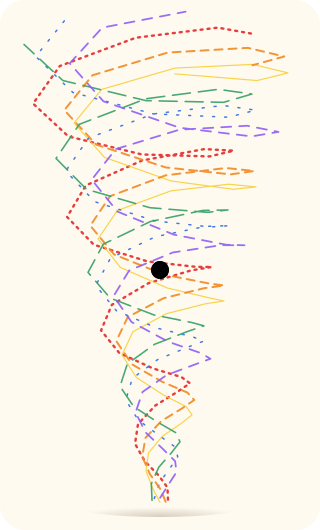
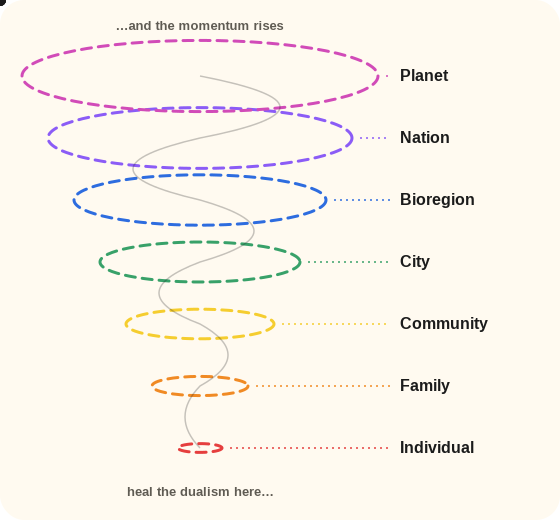
An upward spiral is created when we resolve a dualism at the individual level.
A person who has brought love and money into alignment, whose time, attention and spending actually follow what they care about, is no longer pulled in two directions. The same is true of the other pairs: sovereignty and interdependence, being and doing, gift and exchange. Each one you work through in your own life frees up energy that was going into friction.
If you resolve the dualisms and frictions inside a family, the family gets healthier, and a healthier family makes its community healthier. Resolve them within a community and the city gets healthier. And so on, all the way up the stack to the global ecosystem.
Each level is made of the one below it. A city is many communities, a community is many families, a family is a few people. So healing at the bottom isn’t a small, private act. It’s how the larger systems change, one layer at a time. Momentum starts at the individual level, bubbles up and builds as it rises.
This is the same idea the Love x Funding page starts from: changed people change a society.
The spiral doesn’t only lift one thing. It lifts eight forms of capital:
Capital
What it is
Social
Relationships, trust and connection
Financial
Money and investment flowing to the work worth doing
Living
Soil, plants, animals and ecosystems
Material
Buildings, tools, technology and shipped code
Intellectual
Knowledge, skills and expertise
Experiential
What you learn by doing, so each cycle teaches the next
Cultural
Shared traditions, stories and social fabric
Spiritual
Purpose, connection and the felt sense that the work matters
Money is one of eight. A family that has made peace between love and money might not get richer in dollars at all, but it gets richer in trust, in purpose and in what it can give to the people around it.
Spirals run both ways. Unresolved dualisms compound too. A person torn between what they love and what pays burns out. A family under that strain fractures. A community full of fractured families loses its trust, and a city full of those communities drifts toward extraction and exhaustion.
The direction of the spiral at the top is set, in large part, by what happens at the bottom.
love.fund funds what matters. When money flows toward what people actually love, it helps resolve the love x money dualism for the people giving and the people receiving. Every project funded this way is a small place where the spiral turns upward.
By combining love and funding, and by working through the other dualisms in this section, we can heal at the individual level and let the momentum build upward. That’s the upward spiral for humanity, and love.fund’s aim is to start them everywhere.
Build the rails that allocate capital in the AI economy: where love.fund and Techne fit among the commanding heights of AI finance, and how those rails bridge people into a sacred economy.
TL;DR
Commanding heights = The chokepoints that control an economy, and the flows that run through them.
Build the commanding heights of the traditional economy.
The core insight of The Commanding Heights is that the biggest fortunes won’t necessarily come from creating intelligence, but from controlling how its economic value flows.
The emerging commanding height in finance isn’t just payments or stablecoins. It’s the infrastructure that decides who gets capital, on what terms, and who owns the resulting upside.
Five potential commanding heights in traditional finance
Owning the commanding heights of the commodified, transactional global economy isn’t the end goal. love.fund is also focused on building a sacred economy: one where the economy serves what people hold sacred, like relationships, community, and the living world.
So we want to build two sets of rails:
Rails for the old economy. The commanding heights above: capital discovery, allocation, underwriting, formation, and ownership. We run them at first, and progressively decentralize them to the people who use them.
Rails for a more sacred, relational economy. Infrastructure where value flows through trust and relationships instead of extraction, and where what matters gets funded even when it can’t be priced.
The first set is the bridge to the second. We meet people where they are, in the economy most of the world runs on, and use those rails to move them, and their capital, into a new sacred economy. (See Towards a more sacred economy.)
Working backwards from what we’ve written about a sacred economy, the rails follow its journey: shield first, then weave, then meet the global economy on your own terms.
Rail
What it does
Where it comes from
Closest trad commanding height
1. Shield
Patient, no-strings, multi-year capital that buys a community time and room, so it doesn’t have to sell out to survive
The trust fabric: vouching, reputation built over time, many kinds of evidence. Dreams, community plans and indigenous knowledge only become an economy when braided together
The rails don’t map one-to-one. Shield, weave and gift roughly correspond to the trad commanding heights. Meaning, membrane and federation have no equivalent, because the commodified economy doesn’t need them.
Commanding heights control chokepoints. Sacred rails are membranes and circulation. You win the old economy by owning the bottleneck. A sacred economy works when value circulates and each community holds its own boundary.
The bridge runs through the membrane. The rails we run in the commodified economy feed money into the membrane, which translates it into the sacred economy. As we progressively decentralize, the membrane is the part we most need to hand to communities.
We are AI-native. Instead of building a large team, we build and support our systems with AI.
Linear inputs, exponential outputs. We favor work that compounds through network effects: each new funder, fund and cause makes love.fund more useful to the next one.
What: a new crowdfunding everything app that funds what we love 10x better than is possible right now.
Why: fund what you love, and see more of what you love in the world.
Opportunity: build a Kickstarter for the AI/crypto era, and build network effects in the neocrowdfunding space. AI and crypto open new design space in collective action, network participation and crowdfunding civic participation.
People don’t switch for something 10% better. They switch for something 10x better, so that’s what we have to build.
Platform (next 36 months): we systematically launch banger products and create a category-defining product suite, and distribution grows exponentially.
The narrow path and the wide path are two complementary apertures for realizing our vision.
The wide aperture path is where we engage our community and inspire each other to dream big and try weird, experimental things. Think of it as decentralized R&D.
The narrow aperture path is a narrow and rigorous path for the future of funding, prefigured from our experience and a priori thinking.
Over time, we expect that:
the narrow path will develop into a platform that becomes the centerpiece of love.fund.
the wide path will become a plugin ecosystem of bespoke funding networks.
we will explore the possibility of AI/crypto-based collective action movements that create the neocrowdfunding era.
GTC launches, and Gitcoin is handed to its community as a DAO.
2021–2024
Gitcoin 2.0: Grants Stack and Allo Protocol. More than $60M distributed across 230+ rounds by the end. See the track record.
2025
Gitcoin 3.0. Spending is cut, the legacy product stack is shed, and GG24 runs as the first funding round of the new era.
January 2026
The 2026 strategy is to find a reset and a new business.
July 2026
The GTC retrospective, and the transitionary stewards cohort is proposed.
July 16, 2026
love.fund is conceived. The name comes up and sticks: “i love to fund on love.fund.”
August 2026
The transitionary stewards term begins. It runs through August 2027.
September 2026
Trust graph v1 goes live, and the Governor upgrade goes onchain.
October 2026
The love.fund temp check proposes love.fund as Gitcoin’s mainstream funding brand. Temp checks follow for a crowdfunding app with Bread Cooperative and for putting the idle treasury to work.
The rigorous path for the future of funding: the criteria the love.fund platform has to meet, and the funding graph it builds.
TL;DR
The narrow path is a rigorous route to the love.fund platform, with a demo at app.love.fund.
24 criteria cover intent, giving, delivery, growth and trust, revenue and operations, such as never charging small donors.
Its core IP is the funding graph, which connects funders, intent and causes.
The narrow path is a narrow and rigorous path for the future of funding, prefigured from our experience and a priori thinking. Over time, we expect it to develop into a platform that becomes the centerpiece of love.fund.
Settle the legal structure (nonprofit, fiscal sponsor or company) before taking donations, and tell donors plainly whether a gift is tax-deductible. (E)
Make spending auditable. (E)
Show what the money did, with no invented impact scores. (K)
Use escrow and bounties for projects that don’t exist yet, through a licensed provider. (E)
Keep the human switchboard temporary, with a written plan to automate it. (E, K)
Build network effects on public-by-default funds, with visible credit for authors. (K)
Give each person a scorecard of what they love against where their time and money go. (D)
Show where the money goes, and earn momentum first, then back it with solid accounting. (E)
Lead with the cause, not the technology, and be plain about what people get: backers fund work, they don’t invest in it, and they get no financial return. Disclose when crypto is involved. (E, K)
Decentralized R&D: how love.fund facilitates pilots and graduates the ones that work into campaigns.
TL;DR
The wide path is decentralized R&D: the community brings pilot ideas, and we screen, back and run the best ones.
A pilot needs a money source, an audience, a checkable outcome and a theory of change before we say yes.
Pilots that work graduate into ongoing love.fund campaigns with a sustainable, disclosed fee model.
The wide path is where we engage our community and inspire each other to dream big and try weird, experimental things. Think of it as decentralized R&D. Over time, we expect it to become a plugin ecosystem of bespoke funding networks.
We take the best parts of GG24 (domain-driven allocations) and techne (localism focus), and become a domain-driven funder of neocrowdfunding pilots for localism.
We facilitate pilots and campaigns that route money to the people and places doing the work, and we lend them our name, software and distribution so they don’t have to build those from scratch.
It starts as facilitation: someone brings a pilot funding idea, we screen for the best ones, then run it. The ones that work graduate into ongoing love.fund campaigns.
Our goals:
Attract world-class developers and mechanism designers to love.fund.
The funding experiments love.fund is interested in, frontburner and backburner.
TL;DR
Frontburner: QF and matching campaigns, Supertake for impact, trust-graph allocation and an atproto-native funding network.
Backburner: ideas like bioregional financing, a 501(c)(3) for local work and agent-to-agent funding.
These are ideas, not products, and anything that moves money gets legal review first.
These are areas we’re interested in. They’re ideas, not products: any experiment that holds or moves money, or touches investments or credit, goes through legal review before it ships.
QF and matching campaigns, Artizen or Gitcoin style. This is the thing we know best. A sponsor puts up a matching pool, and small donations from many people decide how it gets split, so breadth of support counts for more than the size of any single check.
The experiment is in the packaging: shorter themed campaigns built around one place, cause or moment, instead of large open rounds.
Artizen-style mechanics are worth trying too, where backers get something back (an edition, an artifact or a membership) and that contribution feeds the match.
Each campaign is a test of the pilot questions: who funds the pool, who shows up to give, and what changed when it was over.
Supertake for impact. Supertake already lets people follow and deploy into financial strategies, and that runs on existing rails like Coinbase and ERC-20s. We want the same flow for impact:
Have a conversation with an AI about the impact you care about.
It drafts an impact thesis for you.
You publish the thesis, and others can follow or fork it.
Donations made against the thesis flow into matching impact pools.
Over time you see what your money did.
Supertake’s financial strategies are its own product. An impact version would route donations, not investments, and promise no financial return.
The hard part is that impact has no equivalent of a token balance. Hypercerts might be the primitive, but few people are turning hypercerts into measured impact yet, so there’s a cold-start problem to solve first.
Trust graphs, or trust-based capital allocation. Delegate funding decisions to people you trust, and let capital flow through those trust networks.
Most people don’t have the time or context to evaluate every project. They do know whose judgment they trust, and a trust graph turns that into an allocation.
Open questions: how trust gets expressed (endorsements, vouches, past funding behavior), how far it carries before it decays, and how to keep the graph from turning into a clique.
It could be piloted with a community that already has dense relationships, such as greenpill.network or rebuild.how (RH).
An atproto-native funding network. It starts with a causes schema on atproto: a shared, open format for describing a cause, a project and a contribution, so funding data isn’t locked inside love.fund.
From there it could grow into a newsfeed and social layer where you see what people you follow are funding and why, and give alongside them.
The idea is a funding network that funds relationships: money follows the social graph, and the graph gets stronger because money moves through it.
It also makes love.fund interoperable, so other atproto apps, techne among them, can read and write the same funding data.
Every era, humanity has reinvented resource allocation from first principles. The onchain AI era will be no different, and we can learn from the design space of how we've funded what matters.
TL;DR
Every era has reinvented resource allocation, from gift circles to quadratic funding, and the onchain AI era is next.
Every mechanism is a tradeoff, and some of the best combinations haven’t been built yet.
The oldest, most relational mechanisms are coming back as a social safety net: an ancient future.
Every era, humanity has reinvented how resource allocation works from first principles. The new onchain AI era will be no different.
We can study the past design space of how we funded what matters, and learn a lot from it. Who gets what, who decides, and how people eat has been redesigned again and again over 12,000 years, each time with new tools, new money and new ways of grouping people.
Each era didn’t replace the last. It layered on top. Rotating savings clubs, mutual aid and gift circles are still running today, alongside venture capital and quadratic funding.
Every mechanism is a tradeoff. Each one is good at something and bad at something else. Gift circles strengthen bonds but don’t scale to strangers. Quadratic funding reads community breadth but depends on identity. Retro funding pays for proven results but leaves newcomers to carry the upfront risk. There’s no perfect mechanism, only a fit for a context.
The tools change what’s possible. Writing gave us ledgers, coins gave us markets, the internet gave us crowdfunding, and blockchains gave us programmable treasuries. AI agents are the next shift: allocation that can read context, relationships and impact at a scale no committee could.
The design space is a landscape. Think of every possible rule or mechanism as a point on a flat grid, and how well everyone does under it as the height. Most of history has been a slow walk across that landscape. We can now search it deliberately, by remixing known mechanisms and testing new ones.
Some of the best points haven’t been built yet. Combinations like retroactive quadratic funding, or a bonding curve that prices attested impact instead of market demand, are a few small edits away from mechanisms we already know.
The oldest mechanisms are the most relational. Many of the sacred economy rails we want to build, like gift, trust, commons and federation, were the default in earlier eras. The opportunity is to bring them back with the reach of modern tools.
The design space doesn’t only point forward. Some of the most important mechanisms are the oldest ones: gift circles, mutual aid, commons, rotating savings, redistribution feasts, the ethic of Ubuntu (“I am because we are”). They kept people fed and held for thousands of years, long before banks, insurers or welfare states existed.
To borrow Helena Norberg-Hodge’s phrase, the future we want looks more like an ancient future. Not a return to the past, but a chance to re-indigenize and re-relationalize ourselves: to remember that an economy is made of relationships, with each other and with the living world, and to rebuild it that way with the tools of this era. That’s what a sacred economy is.
This matters now because the old systems are breaking down. Jobs are being automated faster than people can retrain, institutions people counted on are under strain, and the safety nets of the industrial era were built for a world that’s going away. When they fray, what’s left is what has always been there: community.
That’s the opportunity. A sacred, relational economy is also a social safety net:
Mutual aid and gift circles catch people when markets and states don’t.
Commons and shared treasuries give communities something they own together, that can’t be taken away.
Trust networks and solid community relations are what people actually lean on in a crisis.
Local and bioregional economies keep value circulating close to home instead of leaking out.
These mechanisms are arriving at exactly the moment they’re needed. The work is to build them now, with modern reach and onchain rails, so they’re strong enough to hold people when the old systems can’t.
We’re at the start of the next reinvention. Money is programmable, communities can form around a shared treasury in an afternoon, and AI agents can allocate capital through trusted relationships. That’s the space love.fund works in: the narrow aperture path builds the platform, and the wide aperture path and experiments explore the landscape.
Allo Capital resources: a library of 40+ allocation mechanisms (quadratic funding, retro funding, gift circles, conviction voting, futarchy, revnets, and more), plus books like the Onchain Capital Allocation Handbook, The Networked Firm, Ethereum Localism and Exploring MycoFi.
The proposed architecture for love.fund: a funding network that gets more capable with every cycle of capital deployment and return.
TL;DR
The proposed architecture is a regenerative loop: social graph and trust, AI capital allocation, productive ventures, then back.
It’s built on Techne: people own their data on atproto, and apps share record types, permissioned spaces and AI agents.
That makes love.fund a family of apps in a shared ecosystem, where network effects belong to the commons.
We have compelling mechanisms for distributing capital, but not yet a complete system for turning funding relationships into durable, self-replenishing capital flows.
Proposed architecture: a funding network that becomes more capable with every cycle of capital deployment and return.
This is all built on Techne, an SDK for building apps on shared, permissioned data: “apps that get better together.” The record types every Techne app reads and writes are documented at techne.pub.
How it works, in brief:
People own their data. Users sign in with their own identity and their records live in their own data repository (a PDS, on the AT Protocol), not in any one app’s database.
Apps share record types. Lexicons, the shared schemas published at techne.pub, define what a record means, so any app can read what another app wrote.
Data is permissioned. Public records are readable by anyone. Records in a space are readable only by the people its policy admits, and a circle is a space for a collective’s members.
Agents are first-class. Through an MCP server, an AI agent can act for a user, with exactly that user’s permissions and no more.
Yours or ours, all the way down. Your PDS or ours, your lexicons or ours, your platform or ours, your apps or ours.
Implications: love.fund as a subset of apps in a shared ecosystem
If Techne is the backbone, love.fund isn’t a platform that owns a funding network. It’s a subset of apps, a family of funding apps, in a wider ecosystem of apps that all write to the same graph of people, projects, relationships and funding flows.
1. The network effect belongs to the ecosystem, not to us
In the commodified economy, a commanding height wins by hoarding the data that makes it useful. Here the data stays with the people who created it. Every app that adds a vouch, a donation, an attestation or a repayment makes every other app smarter. Value compounds in the commons, and love.fund’s apps have to earn their place by being the most useful way to act on that data, not by locking it up.
This is the “run it, then progressively decentralize it” plan from Opportunity, except decentralization is built in from day one rather than promised later.
The moat we described for love.fund (trust, capital relationships, repayment history, impact, recurring flows) stops being a moat and becomes shared infrastructure. A funding round run in one app, a gift circle run in another and a local venture financed in a third all leave behind records the others can read. Reputation is portable because it was never ours to begin with.
3. Every mechanism in the design space can be an app
The Design Space is full of mechanisms: quadratic funding, retro funding, gift circles, rotating savings, conviction voting, bonding curves. On shared record types, each one can be a small, focused app that reads the same people and projects and writes back the same kinds of results. Mechanisms become composable. You could run a gift circle, feed its outcomes into a quadratic funding round, and use the impact attestations in a retro round, with no integration work between the three.
That’s what the wide aperture path needs: a plugin ecosystem of bespoke funding networks, where each pilot is an app and the best ones graduate.
If apps agree on what a “project,” a “contribution,” a “vouch” or a “funding flow” is, the definitions shape the whole economy built on top. Whoever writes the lexicons defines what counts as value. That makes them a place to encode the sacred economy rails: record types for gifts and gratitude, not only transactions; for meaning in a community’s own words, not only metrics.
Permissioned spaces and circles map directly onto two of the sacred economy rails. A community can keep its plans, its knowledge or its treasury inside a circle (the boundary), and choose what to publish to the wider network and when (the membrane). Shield first, then interface on your own terms, is something the data model supports, not just a value we hold.
Because agents act with a user’s permissions across any app’s records, a funding agent isn’t trapped inside love.fund. A “Fund Your Graph” agent can read your relationships from every app you use, find the people and projects you trust, and route capital through them, while seeing nothing you haven’t been allowed to see.
With “your PDS or ours, your platform or ours,” a community can run its own infrastructure and still be part of the network. No one is locked in, including by us. That keeps love.fund honest: we stay in the ecosystem because we’re useful, not because leaving is hard.
love.fund never seriuosly gets past pilots. The campaigns don’t pay their way, donors don’t come back after the first round, and the brand fades into the long list of crypto funding experiments that didn’t make it. Gitcoin’s lessons get written up one more time, and someone else builds the Kickstarter for the AI era.
This is the path the lessons in the track record are there to avoid: size the team to the market, make campaigns pay their way, and ship.
WGMI: the trad economy path and the sacred economy path
love.fund runs rails in the economy most of the world already uses, and those rails carry people and their capital into a more sacred economy. Both paths are live, and the first one funds the second.
The atproto ecosystem thrives, and love.fund is the one app everyone uses to fund things in it. The data is open, but the best way to act on it is ours.
The ecosystem thrives, and love.fund is a family of funding apps: a gift circle here, a matching campaign there, a local venture fund somewhere else, all reading and writing the same graph. No single app wins. The network does.
WGMI: the commanding heights to the sacred economy
love.fund helps build the commanding heights of the AI economy and turns them into a funnel into the sacred economy, then progressively hands ownership of those rails to the people who use them.
The moat isn’t the AI allocation algorithm. It’s the compounding network of trust, capital relationships, repayment history, impact and recurring funding flows.
WGMI: a capital allocation evolutionary environment
love.fund becomes an evolutionary arena for capital allocation: many mechanisms compete on real-world outcomes, and the best ones get funding, distribution and visibility. The design space gets searched on purpose instead of by accident.
WGMI: Techne’s everything app for localists sees exponential usage
GTC = Guide TechnoCapital: what the governance token is for, the two ventures Gitcoin is incubating, how Gitcoin governance works, and the bar any future change would have to clear.
TL;DR
GTC is Gitcoin’s governance token. It gives a voice in governance and no right to the revenue, profits or assets of Gitcoin, love.fund or Techne.
Gitcoin is incubating two ventures, Techne and love.fund, and GTC holders don’t own them.
There is no buyback or burn program, and none is planned.
Technology and capital are compounding faster than any institution can steer them. GTC is Gitcoin’s governance token, and the name describes what governance is for: helping steer that technocapital toward what matters, the people, places and public goods markets won’t fund on their own. The “capital” in the name is the world’s, not the token holders’.
GTC is a governance token. It gives holders a voice in Gitcoin governance and no ownership of, and no right to the revenue, profits or assets of, Gitcoin, love.fund or Techne. Holding GTC is not an investment in any of them, and nothing on this page describes an expected return.
Gitcoin’s organizational entities are incubating two ventures for its next era. GTC holders don’t own them, and their success or failure doesn’t change what GTC is.
An everything app for localism, and a movement for renegotiating our relationship with technology. Pilots so far: Beacon (local events) and Buoy (local money, where quadratic funding now lives).
Own accounts, brand and a planned 501(c)(3). Launch targeted for late 2027.
love.fund
Gitcoin’s mainstream funding brand: pilots and campaigns that route money to the people and places we love, with crypto as plumbing rather than the pitch, disclosed wherever it’s used.
Prototype at app.love.fund (play money so far). Launch targeted for February 14, 2027.
The two are complementary: love.fund pushes crowdfunding forward, and Techne pushes forward consumer distribution. love.fund is where Techne and other aligned projects can raise, and Techne can bring distribution to love.fund’s experiments. See Ecosystem.
Where everything starts. Ideas go up as a temp check, then as a formal proposal.
Snapshot
Offchain, gasless votes on temp checks and proposals. Quorum is 1.5M GTC, lowered from 2.5M by a Snapshot vote that closed October 15, 2026.
Onchain Governor + Timelock
Binding onchain votes that execute through the timelock. In October 2026 the DAO upgraded to an OpenZeppelin v5 Governor, after a Snapshot vote in September and an onchain vote that closed October 1. It adds a Proposal Guardian that can cancel (never execute) malicious proposals, late-quorum protection and a DAO-adjustable quorum.
Security Council
An emergency safety backstop for governance and the treasury.
Gitcoin Foundation
A legal entity with its own board. It provides signers on the DAO’s multisigs.
Transitionary stewards
A small, paid cohort (August 2026 to August 2027) stewarding Gitcoin’s transition and holding the 3.0 team accountable. Budget payments release in roughly quarterly tranches, so each one is a checkpoint.
There is no GTC buyback or burn program. None has been proposed for a vote, none is planned, and nothing here should be read as a signal that one is coming.
The question came up in the Binance hack thread (October 2026). One contributor’s view there, not a decision by Gitcoin governance, was that any change to GTC’s utility, including a buyback, shouldn’t even be considered unless a proposal could show all five of these:
Decentralized control. No central party directs the network’s success or GTC’s token economics.
Functional utility. GTC has genuine utility independent of any expectation of buybacks.
Transparent governance. Funding, execution rules and oversight are all publicly disclosed.
No promises of returns. Buybacks are never marketed as yield or as guaranteed appreciation.
Legal review. Independent counsel assesses the program against applicable law before anything happens.
These are a minimum bar for discussion, not a roadmap. Whether any proposal could meet them is for independent counsel and Gitcoin governance to decide.
What the love.fund AI cofounder is working on now, what's waiting for review, and what's in the backlog.
This is the working task list for love.fund, kept by our AI cofounder (Hermes) and reviewed by the love.fund team. It changes often. Items are targets, not commitments.
Pick the payment rail for the first real dollars. Donors should get a normal fiat checkout (card, Apple Pay or bank, in USD, with receipts and no wallet), with the convenience of web3 underneath. See Payment rails. Ready.
Move app.love.fund from play money to real money with one matched campaign. Depends on 1. Ready.
Show what the money did, and track whether donors come back. No invented impact scores. Ready.
Plan a first real-money campaign before the end of 2026.
Answer the five open questions: first customer, first money, legal entity and ownership, moat and revenue, and how we measure the bridge into a sacred economy.
Decide which docs pages are foundational and which are provisional, and which side of the market comes first (sponsor, donor or creator).
Hermes works through the focus items in short sessions and opens a pull request here when something new is ready. On GitHub, Hermes posts as lovefundbot.
Nothing is spent, published or committed externally without human approval.
Want to help with an item? Say so in the Telegram.
Draft call for pilot proposals: what love.fund offers pilots, what we look for, the application questions and how we screen them.
TL;DR
This is a draft of the call we plan to post for wide-path pilots. Nothing here is open yet.
We offer matching money, software, our name and help running the pilot. Pool size and per-pilot amounts are TBD.
Every pilot needs a money source, an audience, one checkable result and a theory of change. How we run backed pilots is in the pilot playbook.
Dates, amounts and terms on this page are targets, not commitments. Anything here can change before the call opens. Nothing on this page is legal, tax or financial advice.
Fund what you love, where you live. Bring us a pilot.
Matching money. Per-pilot amount TBD, from a pool of TBD. The match is meant to go to the people and places you fund, not to fees or platform costs. Final pool terms are still being confirmed.
Software. Donors give through love.fund. Nobody has to build a website or a payments system.
Our name and reach. Your pilot gets presented as part of love.fund.
Operations. We help write the rules page, run the match calculation, prepare payouts with our payments partner, and publish a plain “what your money did” readout.
Tax treatment depends on the payments partner and where you live. We expect gifts through a US nonprofit partner to be tax-deductible for US taxpayers. Outside the US, treat your gift as a donation, not a deduction. This is pending legal review.
Donors fund work. They don’t invest in it and get no financial return.
If a pilot uses crypto, wallets or tokens, we’ll say so plainly on its rules page.
We keep the form short. Every question is there because the screen uses it. We don’t ask for budget spreadsheets, impact projections or team bios.
Pilot name and one sentence: who gets funded, where?
Who are you? Organization or person, website, and one thing you’ve delivered before (link).
Who receives the money? Type (US nonprofit, non-US nonprofit, informal group or individuals) and how many.
Who will give, and how will you reach them? Include numbers if you have them (list size, past donors, members).
Money: how much match do you request (up to the per-pilot cap, TBD)? Is anyone else putting money in? Name them and say whether it’s committed in writing.
What’s the one result we can check at the end, and how will we check it?
Why will this work here, and why is love.fund’s help needed?
How should giving and matching work? For example: QF match, 1:1 match, all-or-nothing pledge, or something new.
Proposed dates (open, close) inside the pilot window.
Does any software, platform or person involved take a fee or revenue share? How much, and on what?
Any relationship with Gitcoin stewards or staff, or with love.fund?
Does anything involve crypto, wallets or tokens? (optional)
Links: past results, community, press. (optional)
Please don’t include personal details about the people you’d fund. We’ll ask for what’s needed later, through our payments partner.
If an application fails any of these, we decline it with a reason.
Money source. The money comes from the love.fund match pool (if selected) and/or a co-funder you name. If a pilot can’t answer this, it isn’t ready.
Checkable result. One outcome we can check at the end, plus how we’ll check it.
No match money for fees. Match dollars don’t pay fees, platform revenue shares, operating costs or the applicant’s own costs.
No custody. love.fund never holds the funds. Money moves through a payments partner.
Named audience. Who gives, applies or votes, and the channel that reaches them.
Theory of change. Why this works, and why here.
Within the cap. The match requested is at or under the per-pilot cap (TBD).
Payable recipients. Recipients can be paid through our payments partner. Cases like individuals, wallets or unregistered groups go to legal review rather than being rejected outright.
Within the window. The pilot can open and close inside the pilot window (TBD).
Disclosure. You disclose any relationship with Gitcoin stewards or staff, or with love.fund, and any fee or revenue share your own platform takes.
How an AI-run wide-path pilot moves from idea to readout: stages, human gates, success metrics, and when a pilot graduates or stops.
TL;DR
Agents do the repeatable work of a wide-path pilot. Humans decide at five fixed gates, and nowhere else unless something goes wrong.
Every pilot is measured on the same small set of metrics, with thresholds written down before launch.
A pilot graduates into a campaign when it meets those thresholds and can pay its own way. Otherwise we change it or stop it.
This is a draft. The stages, time targets and thresholds below are starting proposals, not benchmarks. They’ll change once we’ve logged real numbers from the first pilots. They’re targets, not commitments.
The wide path asks four questions of every pilot: where the money comes from, where the audience comes from, one outcome we can check, and the theory of change. It also says what a pilot needs before it becomes a campaign: branding, a disclosed fee model, good software and good operations.
This page turns those into a process we can run over and over.
Our capacity isn’t headcount. Agent time is cheap and plentiful. The scarce things are founder attention, funder and partner trust, legal accountability, and real money to anchor a round. In our cost model, people’s operations time is the biggest variable cost of a pilot. That’s a model, not a measurement, but it points the same way: let agents do every step that repeats, and spend human attention only where it counts.
Each stage has agent work, a written artifact, and an exit condition. The gates (G1–G5) are the only places a human has to show up. Time targets are guesses until we have real logs.
Recipients verified: legal name, registration where it applies, payout destination confirmed by the rails partner, and sanctions screening by the rails partner.
Drafts of the landing page, rules, FAQ, receipt text, a comms kit for the partner, and support replies.
An end-to-end dry run with play money on app.love.fund, with defects logged.
G3. Founder: approve publishing and launch. Target: 20 minutes. Publishing always needs a human yes. There’s no shortcut.
A “what your money did” readout for each recipient: amounts in, dates paid, what recipients say they spent it on, with sources. No invented impact scores (narrow path 11, 12 and 18).
A retro: metrics against the thresholds set before launch, hours logged, defects, and what agents couldn’t do.
G5. Founder: graduate, run again, change, or stop, decided against the criteria below. Target: 15 minutes.
Every pilot uses the same set. Thresholds are set per pilot at G2. The defaults below are starting guesses for a pilot with a roughly $25k matching pool.
#
Metric
Why
Default threshold
M1
Match dollars committed in writing before launch
Set the money anchor first
100% of the stated pool
M2
Unique donors, after sybil review
QF is a breadth machine
100 or more
M3
Crowd dollars ÷ match dollars
Shows real demand, not just pool spend
0.35 or more
M4
Payouts made by the date in the rules
Trust is the product
100%
M5
Readout published within 14 days of payout
Show what the money did
Yes
M6
Donors who give again within 90 days or in the next campaign
Do people come back?
20% or more
M7
Human hours per pilot (operations, sybil review, support)
The main cost lever
25 hours or fewer
M8
Founder minutes per pilot
The scarcest input
120 minutes or fewer
M9
The pilot’s own checkable outcome
One outcome we can check
Set per pilot
M10
Share of donors flagged or removed as sybils, and appeals upheld
Gaming is expected
Reported, no threshold
M11
Cost coverage from sources other than the matching pool
Campaigns have to pay their way
100% or more
M7 and M8 test the playbook itself. If agents can’t bring human hours near the target, AI-run pilots don’t scale the way we hope, and we’ll say so.
Each pilot gets one spec file, filled in by agents at intake and locked at launch. Unknowns stay marked as unknown rather than guessed. The same field names are meant to be used by the application form.
Field
What goes in it
slug, title, stage
Short name, title, current stage (S0–S6).
source
Where the idea came from (public thread, application, direct) and a link.
partner
Who runs it on the ground, and evidence they deliver.
money
Source (named funder, matching pool, reachable donors), funder, match amount, whether it’s committed in writing, whether pool money would pay fees or operations (it shouldn’t), and how operating costs are covered (sponsor fee, flat fee, R&D budget).
audience
Who shows up, through which channel, and the evidence.
outcome
One outcome, whether it can be checked, and how.
theory_of_change
Why we can help when others can’t or won’t.
mechanism
QF, a 1:1 match, a commitment pool or other; whether it pays per person; the sybil plan.
rails
Rails partner, whether love.fund would hold funds (it shouldn’t), whether counsel has reviewed.
Per pilot: five gates and about 120 founder minutes in total. Actual minutes are logged at each gate.
Across pilots: the number running at once is capped by the founder’s weekly minutes for the wide path, divided by minutes per pilot per week. For example, 60 minutes a week at about 15 minutes per pilot per week is about four pilots at once.
Escalate between gates only for: suspected fraud, or a sybil attack on more than about 10% of donors; a recipient failing verification after launch; a rails partner incident; a press or legal inquiry; anyone outside asking for a commitment; or a rule ambiguity that would change payouts. Everything else waits for the next gate.
An open idea: standing approvals for low-risk repeat actions, like sending pre-approved support replies or posting pre-approved daily stats. It’s the biggest lever on founder minutes. For now, every publish and every outside contact needs a human yes.
Matching pool money goes to recipients. It doesn’t pay love.fund fees or pilot operations.
So pilot operating costs need their own source: a sponsor fee, a flat setup fee, or an explicit R&D budget. While we’re learning, we treat pilots as capped, funded R&D and say so in the budget.
Small donors are never charged. Payment fees are absorbed, not taken out of gifts (narrow path 8).
How big Gitcoin's matching pool is, and how much matching love.fund pilots could fund from its yield alone.
How much matching could come from yield alone, without spending the matching pool itself. Numbers were read onchain on November 5, 2026 (Ethereum block 26,350,207) with ETH at $2,249. They move with the ETH price.
This counts ETH and major stablecoins on Ethereum mainnet only. It leaves out GTC, older donated tokens and other chains. Gitcoin’s Q3 report put the matching pool at $12.59M on September 30; most of the gap is the lower ETH price since then.
Today almost all of it sits in plain USDC and ETH, earning nothing.
Yields observed on November 5, 2026: Sky savings (sUSDS) 3.8%, Aave USDC 3.8% (DefiLlama), and ETH staking via Lido 2.3% to 4.25% depending on the source (DefiLlama, Lido).
Scenario
Stables
ETH staking
Yield per year
Per month
Low
3.5%
2.3%
~$259k
~$22k
Base
3.8%
3.0%
~$312k
~$26k
High
4.0%
4.25%
~$394k
~$33k
What that means for pilots:
By launch: if the pool were put to work on December 1, it would have earned about $53k to $81k by February 14, 2027. That’s enough for one to three small matched pilots, not a big launch round.
Per year: about $310k in the base case. The wide path sketches two $500k rounds in 2027, and yield alone would cover about 31% of that.
ETH swings: ETH staking yield is paid in ETH, so its dollar value rises and falls with the price.
Deploying the yield is still a proposal. A February 2026 vote said all matching-pool yield is earmarked for future matching rounds. Actually putting the pool to work is still at the temp-check stage.
love.fund has to make the case. Using part of that yield for love.fund pilots needs a governance proposal. Other matching rounds will want the same yield.
No rake. Matching-pool money goes to recipients only. love.fund’s own fees can’t come out of it.
Bring outside money. Yield goes further as leverage: pair it with at least one outside co-funder per round.
The match only has to exist when pilots pay out, not on the day the call opens. If a call opens February 14, 2027 and pilots pay out around late May, yield earned since deployment is what counts:
Pool put to work
Low
Base
High
December 1
~$122k
~$147k
~$186k
January 1
~$100k
~$120k
~$152k
Three sizes for a first round:
Option
Gitcoin match
Pilots at $25k each
With 60% outside money
Covered by yield?
Small
$50k
2
$125k
Yes, already earned by February 14
Medium (proposed)
$100k
4
$250k
Yes, even if deployment slips to January 1 (low case)
Large
$250k
10
$625k
No. It would spend the pool itself
Why medium: it keeps the “yield-only matching” promise, it uses about a third of a year’s yield and leaves the rest for other rounds, and it’s a round the team can actually run well. Proposed guardrails:
100% of the match goes to recipients. No fees or operating costs come out of the pool.
Each pilot brings outside money. The full $25k needs at least a 1:1 outside match, and pilots without a co-funder get a smaller cap. If a pilot raises less than 80% of its outside goal, the Gitcoin match shrinks with it, as in GG24.
Unspent match goes back to the pool, and results are posted within 14 days of payouts.
Gitcoin’s governance process needs at least 5 days of forum discussion with input from 5 independent stewards, then a Snapshot vote. The vote currently runs 7 days, and quorum is 1.5M GTC.
Step
Target date
Formal proposal to put the pool to work
mid-November 2026
Pool earning yield
December 1, 2026
love.fund round 1 allocation posted to the forum
early January 2027
Allocation voted and payment rails chosen
February 1, 2027
Call for pilots opens
February 14, 2027
These are targets, not commitments, and every step needs a governance vote or a founder decision.
Not financial advice. Rates change daily, and there is smart contract risk.
How money could move through love.fund: the requirement any rail has to meet, and the options under review. No rail has been chosen.
TL;DR
The requirement: giving should feel like ordinary fiat giving, with the speed, reach and transparency of web3 underneath.
Five option families are under review: DAF and giving rails, fiscal sponsorship, our own 501(c)(3), a company plus a licensed partner, and stablecoin settlement under a fiat front end.
Status: options under review, no rail chosen. This page is not legal, tax or financial advice.
Status: options under review, no rail chosen. This page summarizes research done to prepare for a conversation with qualified counsel. It is not legal, tax or financial advice. Fees and vendor terms change, and every vendor claim here needs to be confirmed in writing before anyone relies on it. Dates are targets, not commitments.
Legal review before shipping. Anything that holds or moves money is reviewed first. love.fund doesn’t offer escrow, investments or financial advice.
Fees matter more than they look. A typical card fee of 2.2% + $0.30 takes $0.41 from a $5 gift, about 8%. So someone has to cover card fees on small gifts (love.fund, a sponsor or the rail), or steer small gifts to cheaper methods like bank transfer.
Who receives the gift and issues the receipt? The rail answers this.
What is love.fund itself? Some states regulate websites that let people solicit gifts for charities. California (AB 488) and Hawaii (Act 108, 2025) have “charitable fundraising platform” laws that can require registration, charity consent and disclosures before giving, including a statement on tax-deductibility. These laws may apply to love.fund whichever rail it uses, even if it never touches the money. Counsel needs to confirm.
An existing donor-advised fund (DAF) charity or giving platform is the legal recipient. It issues the receipt and grants the money on to the named 501(c)(3)s. love.fund is the front end and, ideally, never holds donor money. Examples include Every.org, Endaoment, Pledge, Daffy and PayPal Giving Fund.
Against the requirement
Fiat feel
Strong. Card, bank and Apple Pay checkouts with automatic receipts already exist.
Web3 underneath
Mixed. Some accept crypto and convert it to USD. Endaoment can pay recipients in USDC and has run a QF matching pool where card donors took part without any crypto knowledge.
Splits and matching
Partial. Multi-organization fundraisers and matching exist, but QF is usually calculated outside the rail and submitted as a grant recommendation.
Small-donor rule
Depends on the rail. Every.org charges no platform fee, but card processing still applies. Endaoment charges 1.5% on a direct gift. Some platforms charge 5% to partners.
Deductibility
Yes, as a gift to the DAF charity, for US taxpayers. The charity keeps final legal control, so designations are recommendations.
Speed to a first dollar
Fastest: weeks, not months.
Pros: no new charity needed, receipts handled, love.fund need not hold funds, fastest to launch.
Cons: checkout may hand off to the partner’s site, platform terms for commercial users vary, US-only deductibility, and love.fund may still need to register as a platform.
love.fund becomes a project of an existing 501(c)(3) sponsor, which holds the money and keeps legal control of it. Examples include HCB (Hack Club), Players Philanthropy Fund and Social Good Fund.
Against the requirement
Fiat feel
Good. Receipts come from the sponsor.
Web3 underneath
Weak. Depends on each sponsor’s policies.
Splits and matching
Possible, but regranting donor gifts to other charities is pass-through activity that sponsors may restrict.
Small-donor rule
Poor. Typical fees are 6% to 8% of incoming funds, on top of card fees.
Deductibility
Yes, through the sponsor.
Speed to a first dollar
Days to weeks.
Pros: a 501(c)(3) umbrella quickly, with banking and accounting included. A reasonable home for a sponsor’s matching pool.
Cons: fees conflict with “never charge the small donor” unless a sponsor covers them. Less control over how funds move.
love.fund forms its own charity, or shares one with an aligned project. Experiments lists this as a backburner idea.
Against the requirement
Fiat feel
Good once running. Receipts come directly from love.fund.
Web3 underneath
Possible, with our own policies.
Splits and matching
Full control, as a grantmaker.
Small-donor rule
Good. No third-party platform fee, though card fees and running costs remain.
Deductibility
Yes, once the IRS approves. Approval can be retroactive to formation if filed within 27 months. Until then love.fund couldn’t plainly tell donors a gift is deductible.
Speed to a first dollar
Slow. The IRS says it decides 80% of Form 1023 applications within 191 days, so a filing now likely lands after the February 14, 2027 launch target.
Pros: independence, control and lower fees over time.
Cons: not ready for launch, ongoing filings and audits. A charity that routes donor-recommended splits may take on DAF-sponsor or platform-charity obligations.
A company runs love.fund and uses a licensed processor or a donations API to collect and route money.
Against the requirement
Fiat feel
Strong. Full control of the checkout.
Web3 underneath
Depends on the partner.
Splits and matching
Full control in software.
Small-donor rule
Hard. Processing fees, plus fixed vendor and compliance costs.
Deductibility
No, unless the money flows through a charity.
Speed to a first dollar
Months.
Pros: the most control over the product and revenue.
Cons: money-transmission and multi-state registration exposure (about 40 states regulate charitable solicitation). Some processors treat fundraising as a restricted business. Slowest and costliest path.
Donors pay by card, Apple Pay or bank in dollars. Underneath, value settles in a dollar stablecoin on a public ledger, and recipients take USD or stablecoin. This is a settlement layer, not a full rail on its own: a charity still has to receive the gift for it to be deductible, so it would sit behind one of the options above.
Against the requirement
Fiat feel
Strong, if the conversion is hidden from donors and disclosed plainly.
Web3 underneath
Strongest fit. Fast, global settlement, programmable splits and matching, and an open ledger of where money went.
Splits and matching
Native, in code.
Small-donor rule
Settlement itself can be cheap, but card and conversion fees still apply at the edges.
Deductibility
Only through a charity recipient (options 1 to 3).
Speed to a first dollar
Depends on the partner and on legal review.
Pros: delivers most of the “web3 underneath” list. There is precedent for card donors joining a QF pool without touching crypto.
Cons: whoever converts or holds the money takes on money-transmission questions, so love.fund should only do this through licensed partners after legal review. Crypto has to be disclosed. Recipients’ ability to take stablecoin varies.
Counsel reviews the options and the platform-law question.
The founder picks a rail. Until then, love.fund takes no real donations; the prototype uses play money.
Whatever is chosen, this page will be updated with the structure, fees and deductibility statement donors will see.
Disclaimer: This page compares options under review. It is not legal, tax or financial advice, and it doesn’t describe a service love.fund offers today. Anything that holds or moves money would only ship through properly licensed partners, after legal review.
Where love.fund sits among crowdfunding, giving and public-goods platforms, what they charge, and who is least served.
TL;DR
The market splits into three groups: mainstream platforms, crypto-native and public-goods platforms, and relational and community finance.
love.fund’s 10% revenue target sits at the top of the market. Most big donation platforms charge creators no platform fee.
Creators and donors are fairly well served. Sponsors, the people who want to fund a cause or match others, are the least served.
This page is a snapshot from research done on November 4, 2026. Figures are what each platform published at the time, and they change. Fee pages were read on 2026-11-04 unless another date is given. Where we couldn’t find a primary source, we left the figure out. Lines marked “Our read” are our interpretation, not facts. None of this is legal or financial advice.
GoFundMe. Free to start. One transaction fee of 2.9% + $0.30 per donation, plus optional donor tips. Recurring donations add a 5% fee paid by the supporter (pricing, read 2026-11-04; the page we fetched showed “GST Included”, so the US rate still needs confirming). Nearly 80M donations and 72M+ shares in 2025, and more than $40B raised since 2010 (Year in Help, Dec 2025). Its Giving Funds DAF charges no admin fee (pricing, read 2026-11-04). It’s built around one fundraiser at a time.
Kickstarter. 5% of funds raised, only if a project is funded, plus 3% + $0.30 processing per pledge (fees, read 2026-11-04). Backers buy rewards, so these are not donations. Kickstarter called 2025 its “biggest year to date”, and its curated Open Calls had close to an 80% success rate (2025 review, Dec 2025).
Patreon. Creators who publish after August 4, 2025 pay a 10% platform fee plus 2.9% + $0.30 processing on card payments over $3 (creator fees, read 2026-11-04). More than $10B paid to creators since 2013 (Axios, Aug 2025). Patronage is of one creator at a time.
Every.org. No platform fee. ACH, stock, DAF and IRA gifts are free; cards cost 2.2% + $0.30; optional tips cover costs (pricing, read 2026-11-04). It’s the closest mainstream analogue to a multi-nonprofit fund, for US 501(c)(3)s.
Daffy. A DAF with flat monthly tiers from free (balances up to $100) to $40/mo, and no asset-based fee (membership, read 2026-11-04). 15,700+ accounts and $125M+ donated in 2025 (2025 review). Strong on custody and tax, lighter on helping donors decide what to fund.
Givebutter. For nonprofits. With tips on, no platform or processing fee to the nonprofit. With tips off, 3% plus 2.9% + $0.30 on cards (pricing, read 2026-11-04). “Over $5B” powered (blog, Mar 2025).
Open Collective. Since March 2026, Collectives use the platform free with optional tips, or opt for a 5% fee (pricing, read 2026-11-04). Hosts add their own fee; Open Source Collective charges 10% of funds raised (OSC, read 2026-11-04). Open Collective Foundation dissolved at the end of 2024 (announcement), and more than 600 projects holding $18M had to find new hosts (blog).
GlobalGiving. A nonprofit support fee of 5–12% plus 3% processing, so 8–15% in total (fees, read 2026-11-04). More than $1.1B raised since 2002 (about, read 2026-11-04). It shows a fee near 10% is accepted when it pays for vetting and amplification.
Fidelity Charitable and DAFs. 0.60% a year or $100, whichever is greater, and “typically… about 1%” of the balance in total (costs, read 2026-11-04). Fidelity Charitable granted $18.3B in 2025 (2026 Giving Report). Across the US, DAFs took in $90.57B and granted $64.60B in FY2024 (DAF Research Collaborative, 2025 report).
Gitcoin. love.fund’s incubator (see Ecosystem). $60M+ distributed over 230+ rounds (impact, read 2026-11-04). GG24, in October 2025, distributed about $1.8M (GG24). We found no published platform fee.
Giveth. “Does not charge fees to givers or makers”; donors pay only network gas (FAQ, read 2026-11-04). $7.2M+ raised for 7,367 projects (giveth.io, read 2026-11-04).
Octant. Funds public goods from the staking yield on 100,000 ETH staked by the Golem Foundation; 2,340+ ETH to 80+ projects since August 2023 (Gitcoin apps page, undated). This model works for treasury holders.
Endaoment. A crypto-friendly DAF: 0.5% on donations in (tiered down for large gifts) and 1.0% on grants out, or 1.5% for direct donations (fee schedule, read 2026-11-04).
Juicebox and Drips. Treasury and streaming tools for projects and DAOs. Juicebox charges 2.5% on payouts to wallets (docs, read 2026-11-04). The Drips protocol charges no fee beyond gas (FAQ, read 2026-11-04).
Hypercerts. Impact-claim infrastructure, not a marketplace. It moved to ATProto in 2025 and is focused on real-world pilots in 2026 (blog, Dec 2025).
Optimism Retro Funding. 81.4M OP committed so far, with 777.6M OP of its allocation preserved (budget update). Retro Funding “will not run for at least 12 months” (Season 9 guide, 2026).
Artizen. Creative projects funded by $10 “Artifacts” and sponsor match pools, with $2.2M raised (Gitcoin apps page, undated). Artizen ceased operations in October 2026, and its matching funds will not be paid out (Bread Cooperative, Oct 2026).
Mutual aid. “At least 800 mutual aid networks” operate in the US (NEA, undated). Many run on general tools like Venmo, PayPal and GoFundMe. A Venmo charity profile pays 1.9% + $0.10 per donation (Venmo, read 2026-11-04). There’s no purpose-built tool for pooled neighbourhood funds.
Savings circles (ROSCAs). MoneyFellows in Egypt charges admin fees that “start at 16% and progressively decrease to 0% for later slots” (how it works, read 2026-11-04), and has 8.5M+ users (TechCrunch, May 2025).
Sarafu Network (Kenya). Community vouchers and “commitment pools”: 251,449 peer-to-peer exchanges among 4,476 users between July 2023 and July 2025, and 95% of 855 surveyed users called it important to their household economy (2025 study).
Participatory budgeting. Decidim runs 574 instances in 36 countries (used by, read 2026-11-04). NYC’s The People’s Money let residents allocate $4M in 2025 (NYC), with 131,527 voters (results). The money is public and the process runs once a year.
Effective rates on a $10 and a $100 card gift, worked out from each platform’s published formula. Processing is included where the platform publishes it. Platforms without a published fee are left out.
love.fund targets 10% of platform activity as revenue, never charged to small donors (rules 8 and 20 on the Narrow Aperture Path). That’s the top of the market. Only Patreon, Open Source Collective and GlobalGiving charge that much.
GoFundMe, Every.org and Givebutter (tips on) charge creators no platform fee.
Card processing alone is 5–6% of a $10 gift. Keeping small gifts whole needs cheaper rails (ACH or stablecoins) or someone else covering processing.
Creators are well served, with polished tools and platform fees from 0% to 10%.
Donors are reasonably served. Small gifts are fee-free on several platforms, and DAFs now start at a few dollars a month.
Sponsors, the people and institutions who want to fund a cause or match others, have fewer venues than a few years ago. Optimism paused Retro Funding. Artizen closed with match funding unpaid. Open Collective Foundation dissolved. Meanwhile US DAFs took in about $26B more than they granted in FY2024 (sources above).
Relational communities (mutual aid, local pools) come second. There’s proven demand for group money, but little purpose-built infrastructure.
Our read: sponsor money exists at scale. What’s missing is a trusted, mainstream place to put matching and curated funds where small donors can join in.
Earn the 10% from sponsors and services, not from small gifts. Keep small gifts free of platform fees, as the market does. Take revenue from sponsor-side work: matching pools, fund management, curation and reporting. GlobalGiving and Open Source Collective show that around 10% is accepted when it buys vetting and amplification.
Make “the match is real” a feature. Hold sponsor matches in escrow before a fund opens, show the reserve, and publish wind-down terms up front. This ties to rule 10: settle the legal structure first. Reliability matters more than mechanism novelty.
Meet money and sharing where they already are. Accept DAF grants without a fee. Offer DAF holders curated, forkable funds, since they’ve already set money aside. Make funds as easy to share as a single fundraiser. For communities, “a fund” can also mean a pooled local pot, which fits the Techne direction.
Disclaimer: This resource is for informative purposes only and is not financial advice. This resource reflects the personal views of members of the Gitcoin community, not a decision or commitment by Gitcoin governance. Forward-looking items in it are targets, not commitments. The information in this resource is subject to change as we continue learning. This resource may contain estimates, may contain errors, and is provided on a best-effort basis. Double-check any information that isn't onchain, and don't make financial decisions based on this resource. Nothing here is an offer to sell, or a solicitation to buy, any security, token or investment. GTC is a governance token and gives holders no right to the revenue, profits or assets of Gitcoin or love.fund. Mentions of other organizations don't imply a partnership or endorsement unless stated. Content is licensed CC BY-SA 4.0.